
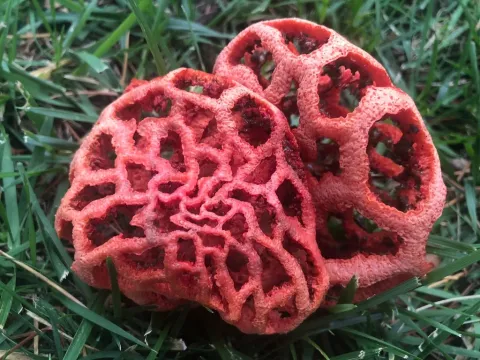
Clathrus ruber
Clathrus
Clathrus ruber, commonly known as the latticed stinkhorn, is a saprotrophic fungus belonging to the Phallaceae family. It is strictly a decomposer and does not act as a plant pathogen.
What the section contains
Clathrus ruber
The fungus feeds on decaying organic matter, such as dead leaves, wood chips, and rotting timber. It lacks the biological machinery to infect or damage healthy, living agricultural plants.
Its lifecycle begins as an egg-like structure, eventually bursting open to reveal a cage-like red structure. This distinctive shape is designed to spread spores effectively through the air and via insects.
In ecological terms, this organism is a beneficial decomposer. It helps break down complex organic materials into simpler substances, returning essential nutrients back to the soil cycle.
Because it does not parasitize crops, agronomists do not consider it a disease. Its presence in a field or garden is a sign of high soil organic content and decomposition processes.
This fungus requires a moist and shaded environment to flourish. It is commonly found in woodlands, gardens, and near decaying wood where moisture levels remain consistently high.
Temperature plays a crucial role in its development. It prefers mild temperatures, typically between 15°C and 25°C, which encourage the rapid expansion of the fungal lattice structure.
In agricultural settings, it may appear in heavily mulched areas or around old tree stumps. These locations provide the necessary organic matter that supports its saprotrophic growth.
High humidity is perhaps the most significant environmental factor. Even in the presence of nutrients, if the atmosphere is too dry, the fungal body will not mature or reproduce successfully.
The distribution of the fungus is also facilitated by human activity, such as moving mulch or soil that contains the mycelium, allowing it to colonize new, suitable environments.