
Cobweb disease of mushrooms
Cladobotryum amazonense
The causative agent of the disease is the fungus Cladobotryum amazonense (also frequently referenced as C. mycophilum). This mycophilic pathogen specializes in infecting the fruiting bodies of cultivated mushrooms, particularly the button mushroom (Agaricus bisporus).
What the section contains
Cobweb disease of mushrooms
The disease is classified as a mycoparasitism. The pathogen spreads via spores that are easily carried by air currents, water droplets, farm tools, and personnel working within the production facilities.
The lifecycle of the pathogen is closely tied to the substrate used for mushroom cultivation. There is typically a short latent period of infection before visible symptoms appear on the mycelium or fruiting bodies.
Spores of the fungus are highly resilient and can survive for long periods in spent substrate, on metal shelving structures, and within the ventilation systems of mushroom farms.
The biology of the pathogen allows it to rapidly colonize the casing layer, forming a dense mycelial web that suppresses the growth of the cultivated mushroom during the early development stages.
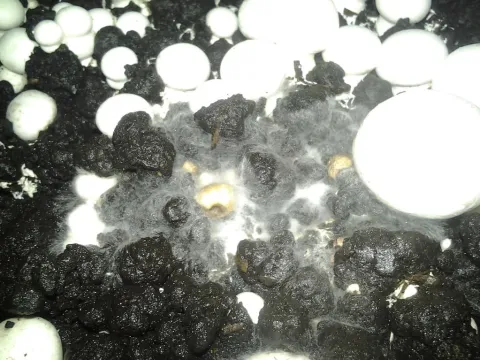
The first visible sign of cobweb disease is the emergence of a fluffy white growth on the surface of the casing layer or the mushroom caps. The appearance resembles a cobweb, which is why the disease is commonly named after this texture.
As the pathogen develops, the web thickens and often turns pink or yellowish. This change indicates massive spore production, which significantly increases the risk of rapid contamination spreading to adjacent cultivation areas.
Infected fruiting bodies become deformed, stems become brittle, and caps develop necrotic spots. Eventually, the mushroom decomposes entirely, turning into a slimy, foul-smelling mass.
The infection often appears as localized spots or patches that, if not managed, quickly spread to cover larger areas of the growing beds or shelves.
- Presence of white fluffy patches on the casing soil.
- Darkening and deformation of young mushrooms.
- Appearance of a pinkish tint during sporulation.
- Rotting of fruiting bodies with an unpleasant odor.
The primary factors contributing to the development of cobweb disease are high relative humidity (above 90%) and insufficient air circulation within the growing rooms.
The optimal temperature for active growth of Cladobotryum ranges between 20°C and 25°C. During this period, the pathogen spreads most aggressively, infecting young crops.
Frequent and excessive watering, which causes water to pool on the casing surface, creates the ideal environment for spore germination and rapid colonization of new surfaces.
Poor sanitation practices, such as failing to remove spent substrate or debris in a timely manner, significantly increase the concentration of spores in the air, triggering outbreaks.
Inadequate filtration in the ventilation system allows pathogen spores to enter production rooms freely from the outside environment or from areas with poor sanitary controls.
Cobweb disease poses a severe threat to the profitability of any mushroom farm. Infection leads to the complete loss of product quality, making the crop unsalable in retail markets.
During mass outbreaks, yields drop drastically, sometimes resulting in total crop failure for a specific flushing cycle, which causes significant financial losses.
Beyond the direct destruction of mushrooms, the presence of the pathogen requires costly sanitation and disinfection protocols, which often force the suspension of production for extended periods.
Infected mushrooms become a source of secondary infection, as spores are spread by ventilation, systematically contaminating all technological zones of the enterprise.
There is also a biological hazard related to the accumulation of fungal toxins in the substrate, rendering it unsuitable for subsequent cultivation cycles without intensive thermal treatment.
The fundamental control measure is strict hygiene. Growers must remove infected spots daily, including a small margin of the surrounding casing soil, to prevent spores from becoming airborne.
It is essential to maintain an optimal microclimate, avoiding prolonged over-saturation of the casing layer and ensuring efficient ventilation to help surfaces dry out quickly after irrigation.
The use of authorized fungicides as a preventative measure or upon the first signs of infection can help contain the spread, though chemical protection must always be paired with good agronomic practices.
Tools and equipment used for bed maintenance must be regularly disinfected with specialized solutions. Staff must follow strict protocols when moving between different cultivation rooms.
After a cropping cycle ends, a thorough terminal disinfection (steaming/pasteurization) of the room is necessary to completely eliminate any remaining spores on shelving and within the HVAC system.