
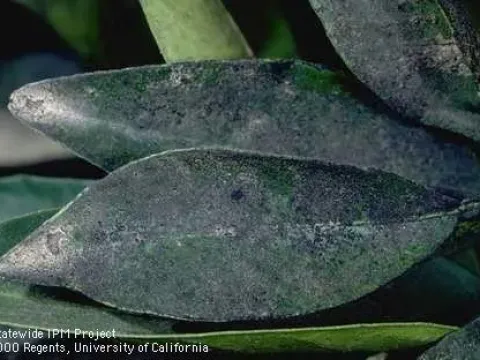
Citrus sooty mold
Chaetothyrium guaraniticum
The causative agent of this disease is the fungus Chaetothyrium guaraniticum, which belongs to the group of sooty molds. This fungus lives as an epiphyte on the surface of citrus leaves and fruits.
What the section contains
Citrus sooty mold
The fungus does not penetrate deep into plant tissues but feeds on honeydew, a sugary excretion produced by sucking insects such as scale insects, aphids, and whiteflies. It forms a dense dark mycelium on the surface.
The biology of the fungus is strictly dependent on the presence of organic nutrients on the plant surface. Spores are disseminated by wind, water splashes during irrigation, or by movement of insects.
The presence of Chaetothyrium guaraniticum serves as a bio-indicator for the presence of honeydew-producing pests. Without the presence of these insects, the fungus usually fails to establish a strong colony.
The life cycle of the fungus is quite resilient, allowing it to survive in various environments as long as high humidity and nutrient sources are available.
The primary symptom is the appearance of a dark brown or black velvety coating on the upper side of leaves and sometimes on fruit. Initially, it appears as small patches, but these expand over time.
As the disease progresses, the soot-like mold covers large areas of the foliage, making the plant look dusty and dirty. The aesthetic quality of the tree is significantly compromised.
The mold is initially removable with physical wiping, but as it matures, it becomes more firmly attached to the surface. In severe infections, the entire canopy can be covered in this dark layer.
Inspecting the underside of the leaves often reveals the source of the infestation, such as dense colonies of scale insects or aphids. Leaves may show signs of yellowing due to reduced metabolic activity.
Fruits affected by sooty mold lose their marketability. The dark layer on the peel is difficult to remove without causing potential damage to the fruit skin during cleaning.
High relative humidity is the most critical factor for the development of sooty mold. Poor ventilation within the canopy or inside greenhouses significantly accelerates the colonization rate.
Densely planted trees with limited airflow create a stagnant microclimate that supports the rapid germination of Chaetothyrium guaraniticum spores.
The availability of insect honeydew is the primary prerequisite. If pest populations are kept under control, the fungus lacks the substrate necessary for its growth.
Periods of prolonged rain or high-humidity weather patterns prevent the leaf surface from drying, which provides the moisture required for fungal mycelium to thrive.
In indoor environments, lack of direct sunlight and insufficient air exchange contribute to the persistence of the disease throughout the year.
The thick layer of fungal mycelium blocks the leaf stomata, which hampers gas exchange. This interferes with the plant's respiration and significantly reduces the overall vigor of the tree.
By covering the leaf surface, the mold inhibits sunlight penetration, reducing the efficiency of photosynthesis. This leads to stunted growth and lower fruit yields.
The presence of sooty mold indicates an underlying pest problem that is already sapping the plant's energy. Combined, these factors weaken the tree's immune system.
Affected plants may experience premature leaf drop, which depletes the tree's nutrient reserves. This leaves the plant more susceptible to other secondary infections and environmental stresses.
Economic damage is twofold: the reduction in yield quantity and the loss of product quality, requiring costly post-harvest cleaning and processing.
The most important control strategy is the management of honeydew-producing pests. Effective insecticide application against scales, aphids, and whiteflies is essential.
Pruning is vital for improving airflow and light penetration into the center of the canopy, which naturally discourages the growth of the fungus.
Physical removal using water sprays can help clean leaves. In severe cases, washing with mild soapy water or specific plant-safe cleaners can restore leaf function.
Fungicides containing copper can be used to inhibit the growth of the fungus. However, these should be applied according to local regulations and the plant's growth stage.
- Regular monitoring for insect pests.
- Sanitary pruning to increase light and air.
- Use of appropriate pesticides to eliminate vectors.
- Maintaining proper irrigation to avoid excess humidity.