
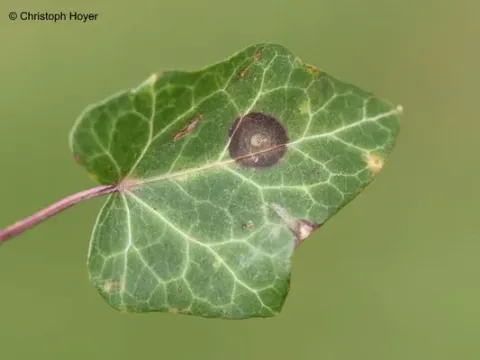
Ivy leaf spot
Cercospora hedericola
The causative agent of this disease is the fungus Cercospora hedericola, which belongs to the group of mitosporic fungi.
What the section contains
Ivy leaf spot
This pathogen specifically targets plants within the Araliaceae family, with ivy (Hedera) being the primary host for the infection.
The fungus infects the leaves of the plant by entering through stomata or small physical wounds on the leaf surface.
It colonizes the internal leaf tissue, extracting nutrients and causing localized cell death, which manifests as distinct spots.
The fungus produces asexual spores called conidia on the surface of the lesions, which are responsible for the spread of the disease to healthy foliage.
The primary symptom is the appearance of small, circular or irregular spots on the leaves, typically surrounded by a dark red or brown halo.
Over time, the center of these spots turns grayish-beige as the tissue dries out and loses chlorophyll.
Under humid conditions, a sparse, olive-gray velvety growth may appear on the underside of the spots, containing fungal spores.
As the disease progresses, these lesions can merge, causing significant leaf distortion and premature yellowing of the foliage.
Eventually, the affected leaves wither, dry out, and drop off the plant, leading to partial defoliation.
Cercospora hedericola thrives in environments characterized by moderate temperatures and high relative humidity.
Outbreaks are most common during periods of frequent rainfall, high-frequency irrigation, or in areas with poor ventilation.
Water sitting on the leaf surface, whether from overhead watering or morning dew, provides the necessary moisture for spore germination.
The disease spreads primarily through rain splashes, wind-blown spores, and the movement of contaminated tools or hands during maintenance.
Crowded planting environments lack sufficient airflow, creating a microclimate that is ideal for the rapid development of the fungus.
The primary impact of ivy leaf spot is the severe reduction of the plant's aesthetic appeal, making it unsuitable for ornamental use.
Heavy infections can severely stress the plant, as the loss of functional leaf area limits the plant's photosynthetic capacity.
Chronic infestation results in stunted growth and a general decline in the vitality of the ivy plant over time.
The disease also makes the plant more susceptible to other biotic and abiotic stresses, potentially leading to death in weak specimens.
An infected ivy plant acts as a persistent reservoir of inoculum, putting surrounding vegetation at risk of infection.
Sanitation is the first line of defense: remove and destroy all infected leaves as soon as symptoms are noticed to reduce spore loads.
Improve cultural practices by watering at the base of the plant to keep foliage dry and increasing spacing to enhance air circulation.
Copper-based fungicides are often recommended for effective control and protection against new infections in the garden.
Systemic fungicides may be used for more serious infestations to prevent the spread of the mycelium throughout the remaining healthy tissue.
Consistent monitoring and preventive applications during high-humidity seasons are essential for long-term ivy health management.