
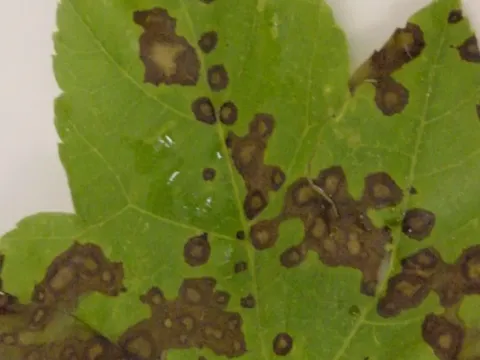
Ivy phyllosticta leaf spot
Phyllosticta hederae
The causal agent of this disease is the imperfect fungus Phyllosticta hederae, belonging to the order Sphaeropsidales. This pathogen specializes in infecting the tissues of evergreen plants, primarily common ivy (Hedera helix).
What the section contains
Ivy phyllosticta leaf spot
The fungus overwinters in infected plant debris, fallen leaves, and stems in the form of mycelium or pycnidia. In spring, under favorable conditions, spores (pycnidiospores) form within the pycnidia and are dispersed by rain splashes, wind, or insects.
The pathogen's life cycle is closely linked to environmental humidity. The infection enters the plant tissue through stomata, mechanical wounds, or natural cracks in the leaf epidermis.
Fungal development occurs inside the leaf tissue, where it feeds on plant cells, gradually destroying the chlorophyll-bearing parenchyma. The colonization process is accompanied by the release of toxins that accelerate tissue necrosis.
After completing the development cycle, new fruiting bodies — pycnidia — form on the surface of necrotic spots, visible to the naked eye as tiny dark dots.
The first symptoms of the disease appear as small, circular spots on the leaves that gradually increase in size. Affected areas typically exhibit a brown or reddish-tan color.
A characteristic feature is the presence of a darker border around the periphery of the spot, which visually separates healthy tissue from the damaged area. A light gray or whitish center often forms within the spot.
On the upper side of the infected leaves, within the necrotic zone, small black dot-like inclusions appear — these are the fungal pycnidia. This is the most reliable diagnostic sign for identifying the disease.
As the disease progresses, spots may coalesce, forming large lesions that cover a significant portion of the leaf blade. This leads to premature yellowing and leaf drop.
In high-humidity conditions, a faint, powdery layer consisting of a mass of fungal spores may appear on the surface of the spots. The infection can also spread to leaf petioles and young shoots.
Disease development depends directly on the level of air humidity. High humidity (above 80%) and the presence of liquid water on leaves are key factors for spore germination of the pathogen.
The optimal temperature range for infection and active growth of Phyllosticta hederae mycelium is between 18–25 degrees Celsius. In cool and rainy seasons, the risk of disease outbreaks increases significantly.
Crowded ivy plantings create a microclimate with poor air circulation, which promotes water retention on the leaf surface. This greatly facilitates the infection process of adjacent plants.
Lack of sunlight and keeping plants in poorly ventilated rooms make ivy more susceptible to fungal infections, including phyllosticta leaf spot.
Mechanical damage to leaf tissues during maintenance or pest activity opens the "gate" for infection, which is often observed when hygiene rules for tools are ignored.
Phyllosticta leaf spot causes serious aesthetic damage, reducing the ornamental value of ivy as a landscape or indoor plant. The spotting deprives the plant of its healthy appearance.
Severe infestation causes mass premature leaf drop, leading to plant exhaustion. Photosynthesis and transpiration processes necessary for normal growth are severely impaired.
In chronic cases, weakened ivy loses the ability to develop properly and produce new shoots. The plant becomes susceptible to other diseases and pests.
In nurseries, this disease can lead to the culling of a large percentage of planting material, resulting in significant economic losses for agricultural enterprises.
If the spread of the fungus is not stopped in time, severe infection can lead to the total death of weakened specimens, especially in young plants.
The first measure of protection is sanitary pruning: infected leaves and shoots must be removed immediately and destroyed (burned or disposed of) to reduce the infection background.
It is necessary to avoid overhead watering, directing the water stream strictly to the base of the plant. It is important to ensure good aeration of the space between plants for rapid drying of the foliage.
Chemical control involves the use of broad-spectrum fungicides. Effective treatments include copper-based products such as Bordeaux mixture, as well as modern systemic fungicides from the triazole and strobilurin groups.
Preventive treatments should be carried out during high-risk periods (humid spring and autumn) at intervals of 10–14 days, according to the regulations for specific product application.
- Disinfection of garden tools.
- Control of humidity levels in greenhouses.
- Regular inspection of plants at early stages.
- Use of healthy planting material.