
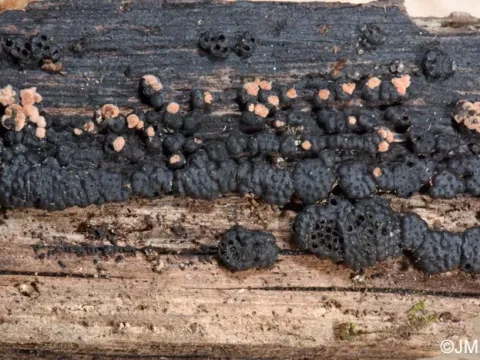
Jackrogersella minutella
Jackrogersella minutella
Jackrogersella minutella is a species of ascomycetous fungus belonging to the Hypoxylaceae family. Historically associated with the Hypoxylon genus, it has been reclassified due to modern phylogenetic studies that clarify its distinct role as a wood-decaying organism.
What the section contains
Jackrogersella minutella
The fungus functions primarily as a saprotroph, but it can act as a weak pathogen on stressed or damaged woody hosts. It specializes in the decomposition of lignin and cellulose, playing a significant role in the forest ecosystem's nutrient cycling.
The fungus develops reproductive structures known as stromata, which are typically small, carbonaceous, and immersed within the bark of its host. These structures protect the perithecia where spores are produced before release.
Biological success of this species relies on its ability to colonize various deciduous trees. Its mycelium penetrates deep into the sapwood, creating a network that effectively breaks down woody tissues to derive energy and nutrients.
Environmental adaptation is a key feature of Jackrogersella minutella. It can remain dormant during unfavorable conditions and quickly activate its metabolism when humidity and temperature levels become optimal for sporulation.
The most visible symptom of an infestation is the appearance of small, black, cushion-like stromata on the surface of branches or trunks. These structures often emerge in clusters, distorting the bark's appearance.
Infected areas of the bark often exhibit localized discoloration, turning darker or greyish compared to healthy tissue. As the fungus matures, the periderm may crack, exposing the underlying infected layers to the environment.
Branch dieback is a common consequence of colonization. Because the mycelium disrupts the vascular tissues, the distal parts of the branches receive insufficient water and nutrients, leading to premature wilting and death.
The wood under the bark often shows signs of decay, appearing brittle or discolored. In advanced stages of infection, the structural integrity of the affected limb is significantly compromised, making it prone to breakage.
- Appearance of small black stromata on bark.
- Localized bark discoloration and drying.
- Cracking and peeling of the outer bark layer.
- Gradual dieback of branches and twigs.
- Reduction in overall tree vigor and growth.
High humidity and moisture are the primary drivers for the development of Jackrogersella minutella. Prolonged wet weather allows spores to germinate and colonize new wood surfaces effectively.
Physical injuries to the host tree serve as entry points for the fungus. Pruning wounds, frost cracks, or damage from insects provide the perfect opening for the pathogen to establish its colony within the wood.
Inadequate airflow within the canopy creates a stagnant microclimate. This lack of ventilation keeps the bark surface damp for longer periods, which is ideal for the survival and spread of fungal spores.
Temperature plays a crucial role in the lifecycle of the fungus. Moderate temperatures between 15°C and 25°C generally accelerate the growth of both the vegetative mycelium and the reproductive structures.
Accumulation of deadwood is a major factor in the disease cycle. The presence of fallen branches or dead twigs in the garden provides an abundant reservoir of inoculum that can infect nearby healthy trees.
The fungus harms plants by systematically destroying woody tissues, which leads to a gradual decline in the tree's architecture. Losing essential branches significantly impacts the tree's aesthetic value and overall productivity.
Chronic infection stresses the host, making it more susceptible to opportunistic diseases and pests. The energy spent by the tree on localized defense mechanisms reduces the resources available for growth and fruit production.
For commercial orchards, the presence of this fungus requires increased management costs. Infected trees may need to be removed to prevent the spread of the pathogen, leading to economic losses and plantation thinning.
In the long run, the pathogen can contribute to the mortality of weakened trees. Without intervention, a minor infection can expand over several seasons, eventually girdling branches or stems and killing the affected plant.
The degradation of wood quality is also a significant concern. Infected timber is brittle, porous, and loses its commercial and functional value, as the mycelium breaks down the complex structural polymers of the wood.
Sanitary pruning is the most effective management strategy. All branches exhibiting signs of stromata or bark damage should be pruned back to healthy wood and immediately destroyed by burning to eliminate the inoculum source.
Maintaining high horticultural standards is vital for prevention. Providing adequate irrigation and balanced fertilization strengthens the tree's immune system, allowing it to better resist initial fungal colonization.
Protecting wounds from pruning or accidental damage is essential. Applying protective wound dressings or antifungal sealants to any exposed wood prevents spores from landing and germinating in the sensitive inner tissues.
Chemical control involving fungicides can be used as a preventative measure. Applications should be timed to coincide with the periods of highest risk, typically during the spring or autumn months when conditions are favorable.
Improving canopy aeration through proper training and pruning creates an environment that dries out quickly after rainfall. Reducing the moisture content on the bark surface directly discourages the fungus from establishing a foothold.