
Golden-eye lichen
Teloschistes chrysophthalmus
Description
Symptoms
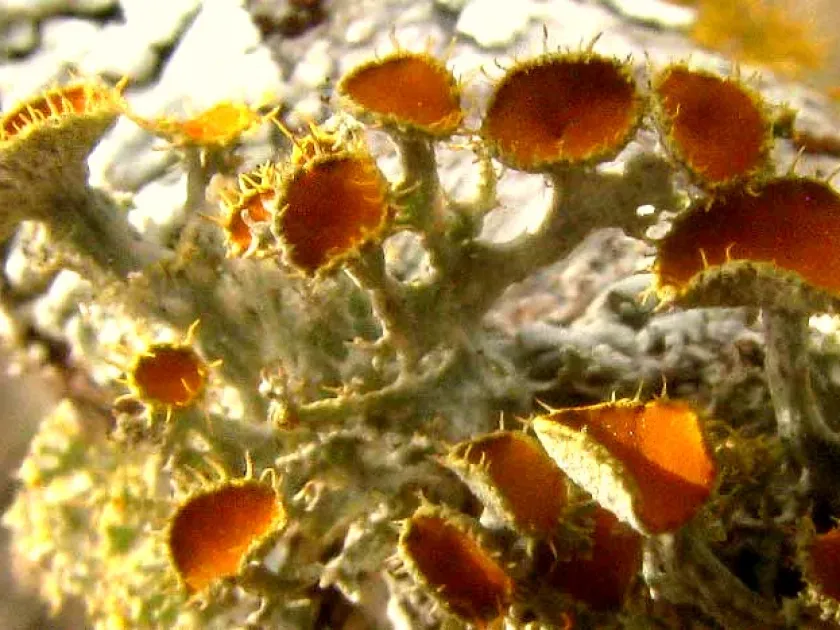
The primary sign of its presence is the growth of bright orange or golden-yellow bush-like thalli on twigs and branches.
The lichen forms dense, shrubby rosettes with prominent, cup-shaped fruiting bodies known as apothecia, which have distinct cilia on the margins.
It typically colonizes the peripheral branches of trees where sunlight is abundant and atmospheric humidity is consistently high.
When the lichen is brushed off, the underlying bark remains healthy and intact, confirming that there is no deep-seated tissue infection.
An abundance of these lichens usually indicates the presence of aging branches or a general slowdown in the tree's growth rate.
Pathogen
Teloschistes chrysophthalmus, commonly known as the Golden-eye lichen, is not a plant pathogen or a disease, but rather an epiphytic lichen belonging to the Teloschistaceae family.
It consists of a symbiotic relationship between fungi and algae, living on the bark of trees without deriving nutrients from the host plant's internal tissues.
Unlike parasitic fungi that invade plant cells, this lichen only uses the surface of the bark as a structural anchor point to exist.
In horticultural practices, it is often confused with disease because it appears as a growth on trees, but it is biologically distinct from any pathogenic agent.
Its vibrant color is due to the presence of secondary metabolites, specifically parietin, which protects the lichen from high light intensity.
Conditions for development
Teloschistes chrysophthalmus is an important bioindicator, as it requires clean air and is highly susceptible to atmospheric pollution.
It thrives in temperate climates with high ambient humidity, which is essential for its metabolic activity and structural development.
Long-lived trees with stable bark textures provide the ideal substrate for the spores to land, germinate, and establish long-term colonies.
The colonization process is driven by wind-dispersed spores that require prolonged periods of moisture on the bark to successfully develop into a thallus.
Orchards with poor ventilation, dense canopies, and lack of maintenance are particularly prone to high levels of lichen coverage.
Why it matters
This lichen causes no direct harm to the tree's health as it does not compete for water or mineral nutrients from the tree.
Indirectly, it may create micro-habitats that harbor small pests, such as scales or mites, under its dense structure on the bark.
Overgrowth on young twigs could potentially impede gas exchange, although this is rarely the limiting factor for a tree's growth.
The presence of significant lichen cover is usually a symptom of stagnant conditions rather than the cause of plant decline.
While it does not kill the plant, excessive colonization is often seen as a sign of an unmanaged, poorly maintained orchard environment.
Protection
Preventive maintenance, such as regular pruning, is the most effective way to improve airflow and reduce humidity within the tree canopy.
Mechanical removal during the dormant season is highly effective for cleaning branches without the need for chemical intervention.
Applying a lime wash to the trunks and main branches can create a hostile environment for lichen spores, preventing future establishment.
For chemical control, a mild application of iron sulfate solution in early spring can effectively eliminate lichen growths on the surface of the bark.
- Pruning for canopy ventilation
- Mechanical cleaning of trunks
- Limewash applications
- Balanced nutrient management
Discussion
No discussions yet — be the first.