
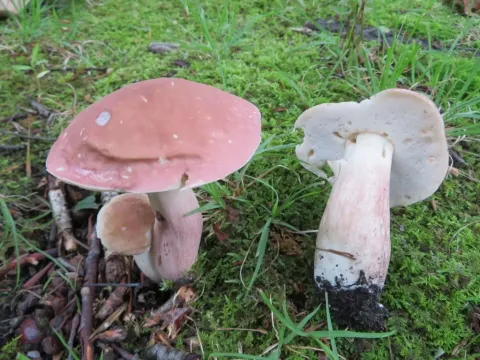
Lilac-brown bolete
Boletus separans
The Lilac-brown bolete (Boletus separans) is not a plant disease agent or a pathogen of agricultural crops.
What the section contains
Lilac-brown bolete
It is a well-known mycorrhizal fungus that forms symbiotic relationships with trees in the beech and oak families.
As a mycorrhizal species, it supports tree health by enhancing nutrient uptake rather than attacking plant tissues.
The fungus is restricted to forest environments where it lives in equilibrium with the root systems of mature trees.
There are no reports of Boletus separans infecting crops, causing root rot, or acting as a parasite in any agricultural setting.
This fungus requires specific environmental conditions found in temperate deciduous forests, such as sufficient shade and moisture.
Growth of the mycelium is strictly dependent on the presence of living host tree roots, ensuring a constant supply of carbohydrates.
Fruiting bodies typically appear during the summer and early autumn months following periods of consistent rainfall.
Soils in their habitat are usually well-drained, acidic, and rich in leaf litter, providing a stable microclimate for the mycelium.
The presence of this fungus is considered an indicator of a healthy and undisturbed forest ecosystem rather than a sign of disease.
Boletus separans poses no threat to agriculture and is categorized as a beneficial forest fungus.
It does not produce toxins or enzymes that could harm or damage field crops, fruit trees, or vegetable crops.
There is no economic impact associated with this species as it does not compete with man-made agricultural production.
Farmers do not need to implement any strategies against this fungus as it maintains ecological balance in natural areas.
The harmless nature of this mushroom ensures that it remains outside the scope of agricultural pest management programs.
No control or protection measures are necessary, as this fungus does not affect crop health or productivity.
Fungicides should never be applied in areas where this species is present, as they would disrupt natural beneficial soil communities.
Management of the species is purely passive, focusing on the conservation of forest habitats where these fungi are found.
Educational awareness for farmers helps prevent unnecessary intervention in forest fringes near agricultural land.
The best practice is to recognize Boletus separans as a component of biodiversity that supports the overall forest health.