
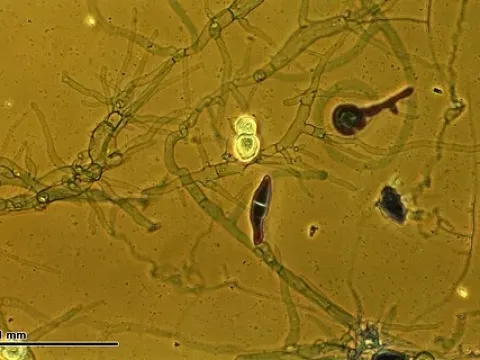
Basidiobolomycosis
Basidiobolus ranarum
The causative agent of this disease is the fungus Basidiobolus ranarum, which belongs to the order Entomophthorales. While often studied in animal biology, this fungus functions as a soil-borne facultative parasite capable of colonizing organic matter and plant tissues.
What the section contains
Basidiobolomycosis
The fungus produces large, multi-nucleated spores known as sporangiospores. These reproductive structures are highly resilient, allowing the pathogen to persist in the soil environment for extended periods until suitable host conditions arise.
Mycelial growth is characterized by rapid development and significant branching. The fungus utilizes powerful enzymatic pathways, particularly the secretion of pectinolytic enzymes, to degrade plant cell walls and access nutrients.
In an agricultural setting, Basidiobolus ranarum acts as an opportunistic pathogen. It primarily targets weakened plants or seedlings when environmental conditions favor fungal proliferation over host defense mechanisms.
Transmission occurs through physical contact with contaminated soil or water splashes. Spores are easily transported via irrigation systems, making the management of water quality essential for preventing spread.
The first clinical signs of infection are the development of localized necrotic spots on foliage or stems. These lesions typically appear brown or dark, eventually expanding to cover larger areas of the plant tissue.
Under conditions of high humidity, a delicate white or grayish fungal mat may become visible on the lesion surface. This indicates active sporulation and rapid colonization by the fungus.
As the disease progresses, tissues lose their structural integrity, becoming soft and water-soaked. This decay process is a direct result of enzymatic digestion of the cell walls by the pathogen.
In seedlings, the infection often manifests as "damping-off" symptoms, where a constriction appears at the root collar. This leads to the plant collapsing and dying prematurely despite favorable growth conditions.
Root system necrosis is a common, though sometimes hidden, indicator. The roots may turn dark and brittle, severely limiting the plant's ability to uptake water and nutrients, leading to rapid wilting.
High moisture levels in both soil and air are the primary drivers of Basidiobolus ranarum infection. Poor drainage and over-irrigation create the ideal environment for spore germination and mycelial spread.
The fungus thrives in warm temperatures, with an optimal range between 25 and 30 degrees Celsius. These temperatures are frequently observed in greenhouse environments, where they promote rapid disease cycle progression.
High concentrations of decomposing plant organic matter in the soil serve as a reservoir for the pathogen. Failure to clear debris from previous crops contributes significantly to the accumulation of fungal inoculum.
Lack of proper aeration and ventilation in greenhouses results in micro-climatic conditions that favor fungal growth. Densely planted crops hinder airflow, keeping the humidity levels at the surface of leaves and stems critically high.
Compacted, heavy soils that retain water excessively are more susceptible to outbreaks. Poor soil structure reduces oxygen availability, which stresses the plant roots and makes them more vulnerable to infection.
The rapid nature of the disease is its most significant threat to crop production. A widespread outbreak can decimate nursery seedlings within days, resulting in massive economic losses for the grower.
Infection significantly reduces the physiological capacity of plants, as necrotic tissues cannot perform photosynthesis. This leads to stunted growth, poor vigor, and ultimately a lower yield in fruit or vegetable quality.
The longevity of the pathogen's spores in the soil creates a legacy of contamination. Future crops planted in the same soil remain at risk unless rigorous sterilization or soil management practices are implemented.
Plants weakened by this fungus are frequently colonized by secondary pathogens, including various bacteria. This creates a disease complex that is significantly harder to diagnose and manage effectively.
The financial impact also includes the cost of labor for removing affected plants, the expense of chemical interventions, and the necessity of re-sowing entire greenhouse benches.
Prevention begins with strict sanitation practices. Removing all plant debris and sterilizing the soil or growing medium using steam or chemical fumigation is essential to eradicate the fungal source.
Implementing a precise irrigation strategy is crucial. Growers should ensure that the surface layer of the soil is allowed to dry out between waterings to disrupt the moisture-dependent life cycle of the pathogen.
Improving greenhouse ventilation and maintaining optimal plant spacing are key cultural practices. Increased airflow prevents the build-up of surface humidity and discourages spore germination on plant parts.
If an outbreak is detected, infected plants should be promptly rogued and removed to prevent further spread. Affected areas should be treated with appropriate systemic fungicides to halt the growth of the remaining fungal mycelium.
Finally, maintaining healthy soil chemistry and supplementing with phosphorus and potassium can bolster plant cell wall integrity. Strong, well-nourished plants exhibit higher tolerance and resistance to pathogenic enzymatic attack.