
Choke disease of grasses
Balansia epichloe
The causal agent of this disease is the ascomycete fungus Balansia epichloe. It is a specialized, systemic pathogen that establishes an endophytic relationship with its host grass species.
What the section contains
Choke disease of grasses
The fungus grows within the intercellular spaces of the host plant throughout its development. It eventually emerges to form a fungal mat, or stroma, which suppresses the plant's reproductive structures.
Reproduction of the pathogen occurs via ascospore dispersal. These spores can travel through the air or be transmitted via infested seeds, creating new infection cycles in healthy grass stands.
As an endophyte, the fungus is capable of surviving within the host tissues even in the absence of obvious symptoms. This makes early detection extremely difficult for field managers and agronomists.
Biological studies suggest that Balansia epichloe has evolved to mimic certain host physiological signals, allowing it to remain undetected while effectively hijacking the plant's nutrient distribution systems.
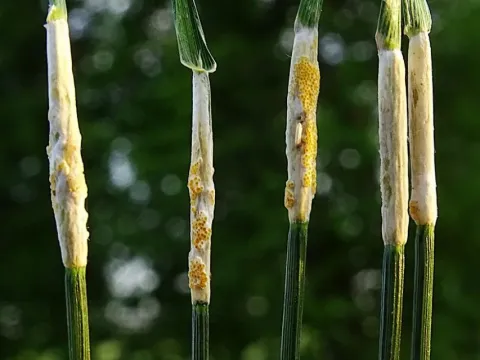
The most distinctive sign is the formation of a white or grayish fungal crust that chokes the developing inflorescence. This stroma forces the emerging leaves to wrap tightly around the aborted seed head.
Plants affected by choke disease usually fail to produce seeds or exhibit significant malformation of the spike or panicle. The structure remains enclosed within the fungal growth, giving it a 'choked' appearance.
In later stages, the stroma darkens and may develop a granular texture as it produces sexual spores. This marks the transition from the vegetative colonization phase to the reproductive phase of the fungus.
Infected tillers are often shorter and lack the vigor of healthy plants. The growth is stunted, and the overall plant architecture is altered to accommodate the systemic presence of the mycelium.
Visual identification is typically easier during the heading stage of grasses, as the absence of fully developed inflorescences in isolated tillers becomes apparent against the backdrop of healthy plants.
Choke disease thrives in environments characterized by prolonged high humidity and cool to moderate temperatures. These conditions are ideal for the development of fungal stromata on the stems.
The timing of infection is critical; the pathogen usually establishes itself during the vegetative stages of the grass. Periods of frequent rainfall during the spring or early summer significantly increase disease pressure.
High plant density and limited air movement within the crop canopy create a favorable microclimate for spore germination and colonization. Reduced sunlight exposure also weakens host resistance.
The disease tends to persist in areas where host grasses are grown continuously. Reservoirs of the pathogen can exist in wild grass populations surrounding the cultivated plots, facilitating recurring cycles.
Soil moisture levels also play a role, as plants under stress from excessive moisture or poor drainage are often more susceptible to the systemic effects of the endophytic infection.
The primary agricultural impact of choke disease is the total loss of seed yield on infected tillers. Since the inflorescence is destroyed, the plant's reproductive potential is completely nullified.
Systemic infection drains the plant of carbohydrates and minerals that are essential for growth. This results in reduced biomass production and weakened long-term health of the grass stand.
Infested seed lots pose a significant risk, as they act as a vector for the disease. Planting infected seed ensures the spread of the pathogen to new locations, leading to widespread field outbreaks.
In forage and turf management, the presence of the fungus can lead to reduced quality and palatability of the grass. Certain species of Balansia are also associated with toxicity in grazing livestock.
The long-term harm involves the gradual thinning of the stand, as infected plants may eventually die out or become less competitive compared to their healthy counterparts, leading to reduced field longevity.
The most important control strategy is the use of disease-free, certified seeds. Sourcing seeds from areas with known infections should be strictly avoided to prevent the introduction of the pathogen.
Implementing a rigorous crop rotation program is essential. Moving away from susceptible grass hosts for several years allows the inoculum levels in the soil to decrease significantly.
Cultural practices such as proper drainage and avoiding high-density sowing can help mitigate the microclimatic conditions favored by the fungus. Ensuring adequate sunlight penetration is beneficial.
Chemical control can be difficult due to the endophytic nature of the fungus, but preventative fungicide applications during the early vegetative stages may offer protection in high-risk zones.
- Rogue out and destroy infected plants to limit the spread of spores.
- Maintain balanced soil fertility to keep the grass healthy and resilient.
- Manage surrounding wild grass areas to reduce potential inoculum sources.
- Monitor fields regularly during the heading phase for early detection and rapid response.