
Honey fungus
Armillaria mellea
The causative agent of the disease is the fungus Armillaria mellea, a basidiomycete responsible for root rot in a vast range of woody and herbaceous plants. It is a facultative parasite capable of surviving as both a saprotroph on dead wood and a pathogen on living tissue.
What the section contains
Honey fungus
A key feature of the pathogen is the formation of rhizomorphs—black, cord-like strands of mycelium that grow through the soil. These structures allow the fungus to actively spread from host to host and survive in the ground for many years.
The fungus produces mushrooms in clusters on infected wood, releasing spores that can travel by wind. However, the most significant threat to agricultural crops is the underground expansion of the rhizomorph network.
Due to its biological flexibility, the fungus can persist in the soil by decomposing organic debris, making it a persistent threat in garden and agricultural environments.
Susceptible crops include Arabica coffee, Robusta coffee, Fuchsia, common hop, walnut, sweetgum, cassava, and geranium.
Early symptoms include a general decline in plant vigor, such as premature yellowing of leaves and reduced foliage size. The tree or plant may exhibit crown dieback, which is a classic indicator of impaired nutrient and water uptake.
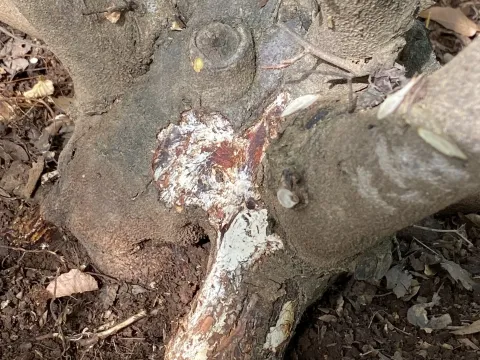
Under the bark near the root collar, one can observe white, fan-shaped mycelial sheets. These are a diagnostic sign of the infection, often accompanied by a distinct mushroom-like smell emanating from the decaying wood.
Dark, string-like rhizomorphs are frequently visible on the root surface, resembling roots themselves but darker and tougher. Their presence confirms the presence of the pathogen in the soil surrounding the plant.
In advanced stages, clusters of honey-colored mushrooms appear at the base of the trunk or on nearby stumps. Their emergence indicates that the fungus has already severely compromised the internal wood structure.
The infected roots become brittle and exhibit a characteristic white rot, often demarcated by thin, black lines of fungal growth through the tissue, marking the zones of infection.
The development of Armillaria mellea is favored by high soil moisture and moderate temperatures. Sites with poor drainage or chronic waterlogging are particularly prone to severe outbreaks.
Plants stressed by drought, poor nutrition, or existing insect damage are more susceptible to infection. A robust root system in a healthy plant can often resist initial colonization attempts by the fungus.
The presence of old tree stumps and dead organic matter in the soil provides a perfect reservoir for the fungus. These sources allow the pathogen to gain a foothold before attacking nearby healthy vegetation.
The disease typically spreads in patches, moving from an infected host to adjacent plants through root-to-root contact. This creates expanding zones of mortality in plantations and gardens.
Mechanical cultivation can unintentionally spread small fragments of rhizomorphs to uninfected areas, accelerating the expansion of the fungal population across the field.
The primary damage is the destruction of the plant's root system, leading to total physiological failure and death. Because the damage occurs underground, it is often irreversible by the time symptoms appear above ground.
In agricultural settings, the impact is severe, often resulting in high mortality rates for crops like coffee or nut trees. Replacing established plantations is costly and time-consuming, leading to significant economic losses.
The insidious nature of the disease makes early detection difficult. By the time a plant shows outward signs of decline, the root system is usually completely colonized, making recovery impossible.
An infected plant acts as a permanent infection source for the entire neighborhood. If left unmanaged, the fungus can clear large areas of vegetation, turning them into hostile environments for sensitive species.
Furthermore, the decay induced by the fungus ruins the commercial value of the wood and can weaken the structural integrity of the plant, increasing the risk of windthrow.
Effective control centers on strict sanitation: removing stumps and all subterranean root remnants immediately after a plant dies. Eliminating the primary food source is crucial for breaking the disease cycle.
To prevent the spread to adjacent healthy plants, creating physical barriers or trenches around infected zones can isolate the root systems and stop the movement of rhizomorphs.
Maintaining strong plant health through proper irrigation, fertilization, and pest management is essential. Avoiding conditions that cause root stress is the best way to prevent primary infection.
If an infection is identified, the affected plant should be removed with as much of the root system as possible. The soil can be treated or left fallow to reduce the inoculum level before replanting with resistant species.
- Monitor the base of the trunk regularly for signs of mushrooms.
- Avoid replanting highly susceptible crops on sites where infection was present.
- Ensure excellent drainage in all growing areas to discourage root rot.
- Prune and sanitize the garden, ensuring no dead wood remains in contact with soil.