
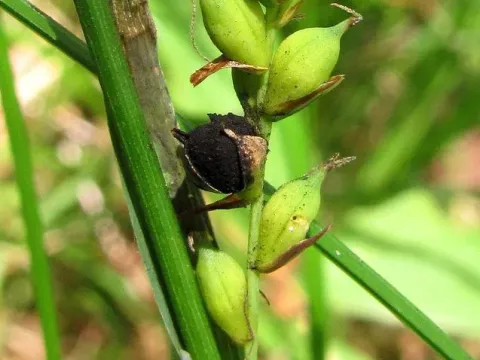
Sedge smut
Anthracoidea caricis
The pathogen responsible for this disease is the specialized fungus Anthracoidea caricis, a member of the Ustilaginales order. It is an obligate parasite that specifically targets various species within the Carex (sedge) genus.
What the section contains
Sedge smut
The lifecycle of this fungus is intricately linked to the growth of its host plant. The fungus survives the winter either as mycelium within infected plant tissues or as dormant teliospores residing in the soil, awaiting favorable conditions for the next growing season.
Reproduction is driven by teliospores, which form dense, black, powdery masses. These spores are highly resilient to harsh environmental conditions, allowing the pathogen to persist for several years in the environment.
The fungus invades the generative organs of the plant during the early stages of their development. Once established, the pathogen consumes the internal tissues, effectively replacing the plant's ovaries with its own mass of spores.
This pathogen consists of multiple strains or forms, each adapted to specific species of sedge, which complicates management efforts in diverse botanical environments.
The primary visual indicator of Sedge smut is the dramatic transformation of the plant's spikelets. Instead of developing normal seeds, the spikelets develop hard, black galls filled with spores.
As the spores mature, the scales of the spikelet open, revealing a dark, dusty mass of teliospores. Infected spikelets are typically swollen, distorted, and display an unnatural color compared to healthy plants.
Infected plants often show signs of stunted growth or premature senescence. Flowering stems may appear shorter than normal, and the inflorescence may struggle to emerge from the surrounding leaf sheaths.
The mycelium expands along the central axis of the inflorescence, systematically infecting every segment until the entire spike is transformed into a spore-bearing structure.
- Spikelet distortion and swelling.
- Black, powdery spore masses replacing seeds.
- Discoloration of the infected reproductive parts.
- Reduced vigor and stunted overall growth.
Sedge smut thrives in conditions characterized by high atmospheric humidity and moderate temperatures. Moisture is essential for spore germination and the subsequent infection of new host tissues during the flowering period.
The pathogen is primarily spread via wind and rain splashes, which transport the spores from infected spikelets to healthy plants in the surrounding area.
Continuous presence of sedge in the same location without rotation or management encourages the buildup of a significant spore bank in the soil. Dense stands of sedge also provide the microclimate ideal for rapid infection spread.
The temperature range between 15°C and 20°C is considered optimal for the pathogen's activity, during which the infection process is most aggressive and effective.
Surface moisture on inflorescences during the critical flowering window is a prerequisite for the fungus to successfully infiltrate the pistils of the sedge flowers.
The main impact of Sedge smut is the significant reduction in seed production and vitality in wild sedge populations and hay meadows. This directly affects the quality and nutritional value of forage harvested from these areas.
In seed production nurseries, the presence of Anthracoidea caricis can lead to total crop failure and the necessity to discard all harvested material due to contamination.
Spore masses present on harvested fodder may pose health risks to livestock. Ingestion of heavily contaminated hay can cause irritation to the mucosal membranes of the respiratory and digestive tracts in animals.
The competitive ability of infected sedges is significantly lowered, leading to a gradual loss of these plants from the ecosystem and a subsequent shift in plant community structure toward less desirable species.
The accumulation of teliospores in the soil creates a persistent reservoir of inoculum, making it difficult to re-establish healthy stands for several seasons after an outbreak.
The most effective management strategy is rigorous monitoring of the seed source. It is critical to ensure that no seeds are collected from areas exhibiting symptoms of smut infection.
Cultural control measures involve early mowing of sedge populations before the spores reach maturity and begin to disperse, thereby reducing the spread of the pathogen.
Drainage of waterlogged fields where sedge is prevalent can help create a less favorable microclimate for the fungus, effectively suppressing the disease cycle.
In specialized horticultural or botanical settings, systemic fungicides may be used as a seed treatment to protect new plantings from initial infection by smut fungi.
Regular scouting and the physical removal (uprooting) of infected individual plants during the early stages of the season are effective at curbing localized outbreaks before they spread across the entire stand.