
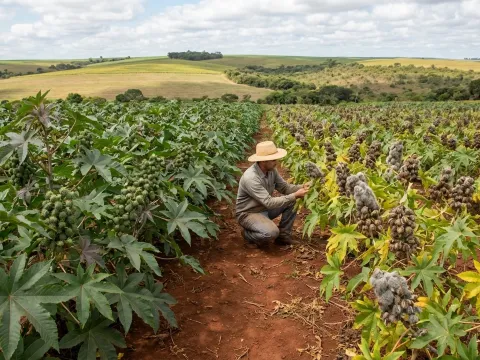
Castor bean grey mold
Amphobotrys ricini
The causal agent of grey mold in castor bean is the fungus Amphobotrys ricini (formerly classified as Botrytis ricini), a specialized pathogen affecting the inflorescences of the plant.
What the section contains
Castor bean grey mold
The fungus produces a dense, greyish mycelium and conidiophores that release large quantities of spores, which are disseminated by wind, rain splashes, and insects.
This pathogen specifically targets the floral parts and developing seed capsules, where it invades the tissues and causes rapid necrosis and decay.
The fungus survives between seasons primarily as sclerotia embedded in plant debris or within infected seeds, serving as the primary inoculum for the next crop cycle.
Due to its high reproductive capacity under favorable conditions, the pathogen can quickly spread across large plantation areas during the flowering stage.
Initial symptoms include the appearance of small, water-soaked brown spots on flowers, which rapidly expand to cover the entire inflorescence.
Under conditions of high humidity, these affected parts become covered with a conspicuous grey, fuzzy layer consisting of the fungus’s spores and hyphae.
As the disease progresses, the flower spikes turn dark, wither, and collapse, eventually leading to the total loss of developing seed capsules.
Infected capsules often fail to fill properly, and internal inspection may reveal the presence of small, black, hardened sclerotia within the seed tissues.
Stalk rot at the point of inflorescence attachment is also a common symptom, which causes the entire cluster to bend or break off.
Grey mold epidemics are strictly associated with prolonged periods of high relative humidity, particularly when accompanied by frequent rainfall.
Temperatures ranging from 18°C to 24°C provide the optimal metabolic environment for the germination of conidia and the infection process of Amphobotrys ricini.
Planting densities that limit airflow and trap moisture around the inflorescences significantly increase the susceptibility of the crop to fungal attack.
Physical injuries to the inflorescences, caused by insect feeding or hail, create infection courts that allow the fungus to penetrate the host tissue more easily.
Extended cloudy weather with high morning fog creates a film of water on plant organs, which is essential for the germination and penetration of the pathogen's spores.
Grey mold is a devastating disease for castor bean production as it directly destroys the yield-forming organs of the plant.
Significant economic losses occur due to reduced seed yield and the degradation of oil quality within the remaining seeds.
Seed-borne infection reduces germination rates, leading to poor crop establishment and the need for costly replanting in infested areas.
The disease can cause widespread outbreaks, resulting in yield losses that can exceed 50–70% in high-humidity cultivation regions.
Contaminated fields remain a source of long-term soil infestation, restricting future planting options for castor bean and other susceptible crops.
Effective management begins with the use of clean, certified, and fungicide-treated seeds to prevent the introduction of the pathogen into new areas.
Maintaining adequate plant spacing ensures proper ventilation, which is crucial for reducing the moisture levels required for fungal proliferation.
Strict crop rotation schedules prevent the accumulation of fungal sclerotia in the soil and break the lifecycle of the pathogen.
Deep plowing after harvest is an essential sanitation practice that buries infected crop debris, exposing sclerotia to natural soil microbial degradation.
Targeted fungicide applications during the sensitive early-flowering stage are necessary in regions where environmental conditions favor disease development.