
Castor bean leaf spot
Cercospora ricinella
Description
Symptoms
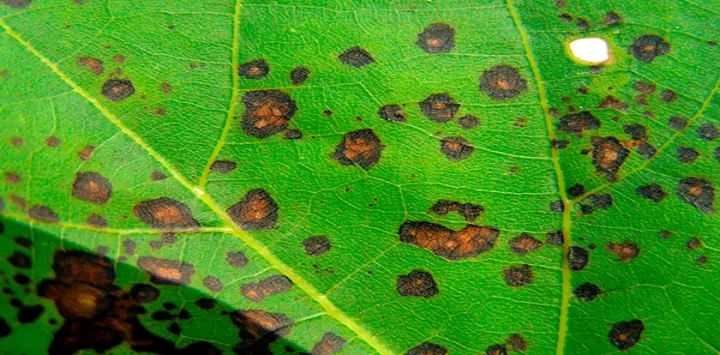
The main sign of infection is the presence of characteristic spots on the castor bean leaf blades. At the beginning of the disease development, they appear as small dots that gradually enlarge.
The spots usually acquire an angular or rounded shape with a grayish-white center and a dark brown border, which is a diagnostic feature of the species.
In high humidity, an olive or gray-colored fungal growth, which is the sporulation of the fungus, forms on the underside of the infected leaves.
Severe infection leads to premature yellowing and wilting of the leaves, which significantly reduces the total photosynthetic surface of the plant.
In neglected cases, the disease can affect not only the leaves but also the stems, causing necrotic changes and general inhibition of castor bean development.
Pathogen
The causative agent of this disease is the imperfect fungus Cercospora ricinella, which belongs to the Hyphomycetes class. It is a pathogen that primarily affects the vegetative organs of the host plant.
The life cycle of the fungus includes the formation of conidiophores with conidia, which serve as the primary and secondary source of infection for castor bean crops during the growing season.
The pathogen survives in the soil and on plant debris in the form of mycelium or sclerotia-like structures, awaiting favorable conditions to resume its vital activity.
The biology of the pathogen is adapted to the climatic conditions of castor bean cultivation regions, allowing it to rapidly adjust to changes in the environment.
Spore dissemination occurs primarily through airborne pathways, assisted by wind and rain droplets that carry conidia to healthy parts of neighboring plants.
Conditions for development
High humidity conditions, especially when combined with moderately high air temperatures, promote the development and active spread of Cercospora leaf spot.
Frequent rainfall, fog, and the presence of dew on the leaf surface create an optimal microclimate for spore germination and pathogen penetration into plant tissues.
Dense castor bean plantings with poor air circulation become high-risk areas because moisture on the leaves evaporates much slower in such conditions.
The optimal temperature for the development of Cercospora ricinella ranges from 20 to 28 degrees Celsius, which coincides with the active growth phase of the crop.
Poor agricultural practices, such as excessive nitrogen fertilization, can also make plants more susceptible to fungal infection.
Why it matters
The primary damage from the disease is the drastic reduction of the assimilating leaf area, which directly affects seed fill and oil accumulation within the seeds.
Premature leaf drop disrupts the normal metabolism of the plant, leading to a decrease in the overall yield of castor bean seeds.
Product quality reduction manifests as a decrease in the thousand-seed weight and worsening of sowing qualities, making the seed material less suitable for use.
Weakened plants become more susceptible to other infections and pest infestations, which exacerbates the general phytosanitary situation in the field.
In years of epiphytotic development, yield losses of seeds can reach significant levels, making the control of Cercospora leaf spot economically necessary.
Protection
The protection system against leaf spot should be comprehensive and based primarily on adhering to proper agronomic practices.
The most important method is the deep burial of plant residues into the soil, as they serve as the main reservoir for infection during the off-season.
Implementing crop rotation, ensuring that castor beans are not returned to the same field for at least 3-4 years, significantly reduces spore accumulation in the soil.
The use of disease-resistant varieties and hybrids, as well as timely weed control, contribute to the improvement of the agrocenosis.
- Application of fungicides at the first signs of the disease.
- Use of healthy planting material.
- Optimization of plant stand density.
- Balanced application of mineral fertilizers.
Discussion
No discussions yet — be the first.