
Slippery skin rot
Burkholderia gladioli
The causative agent of this disease is the Gram-negative bacterium Burkholderia gladioli. It is a persistent phytopathogen that affects various bulbous crops, including common onion and garlic.
What the section contains
Slippery skin rot
The bacterium survives in soil, crop residues, and infected plant tissues. It can persist in the field between seasons and be transmitted through contaminated tools or water.
The disease is classified as a bacterial rot. It invades plant tissues primarily through wounds caused by insects, mechanical cultivation, or natural openings like stomata.
Unlike fungal pathogens, these bacteria thrive by producing enzymes that degrade the middle lamella of cell walls, leading to rapid tissue breakdown.
Due to its ability to form biofilms and tolerate environmental stresses, B. gladioli poses a significant challenge to commercial onion and garlic production globally.
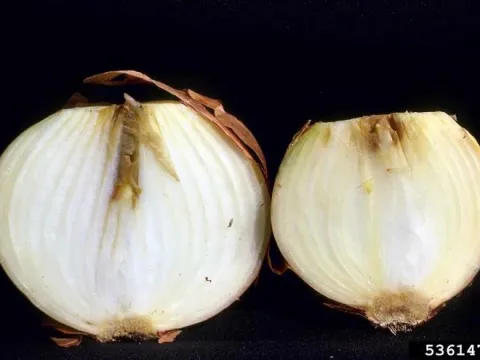
The most characteristic symptom of slippery skin rot is the softening of one or more internal scales within the onion bulb, which may not be visible from the outside during the initial stages.
When an infected bulb is cut open, the affected tissue appears water-soaked, yellowish, or creamy in color, and has a distinct, unpleasant, pungent odor of bacterial decay.
As the disease progresses, the decayed tissue turns into a slimy mass. In advanced stages, the entire bulb loses its structural integrity and can easily slip out of its outer dry skin, hence the name.
In the field, infected plants may show signs of yellowing leaves and premature wilting, often starting from the tips and progressing downwards to the bulb neck.
The neck region often becomes soft and mushy, making it easy for the leaves to separate from the bulb when pulled slightly. This is a primary diagnostic feature for field scouting.
High humidity and warm temperatures are the primary environmental drivers for the development of slippery skin rot. The pathogen thrives at temperatures between 25°C and 30°C.
Excessive irrigation or rainfall late in the growing season significantly increases the risk of infection, especially if soil drainage is inadequate.
Mechanical damage to bulbs during cultivation or harvesting provides entry points for bacteria. Insects like onion maggots also facilitate the spread of the pathogen by wounding the tissue.
During storage, condensation on the bulbs due to improper temperature fluctuations or poor ventilation is a major factor that causes the rapid spread of rot within the pile.
High nitrogen fertilization can lead to excessively succulent tissues that are more susceptible to invasion by Burkholderia gladioli compared to crops grown with balanced nutrition.
The economic impact of slippery skin rot is severe, as it causes massive post-harvest losses. Entire batches of onions can become worthless due to the rapid spread of the bacteria in storage.
The disease reduces the marketable yield, as visual inspection may fail to detect early infections, leading to shipments being rejected by buyers upon arrival.
Fields infested with B. gladioli become risky for future onion cultivation, necessitating long-term crop rotation strategies to reduce the bacterial population in the soil.
Infected bulbs have a very short shelf life, making it impossible to store the crop for extended periods, which disrupts supply chains and market timing.
Quality degradation makes the product unsuitable for processing or fresh markets, resulting in significant financial losses for both growers and distributors.
The most effective management strategy is to prevent infection through rigorous sanitation, proper drainage, and efficient pest control programs.
During harvest, care must be taken to minimize bruising and wounding of the bulbs. Rapid and thorough curing of the onion crop after harvest is essential to close potential infection sites.
Storage conditions must be strictly monitored. Maintaining proper ventilation and preventing temperature fluctuations that lead to condensation is critical for long-term survival of the product.
Rotating onions with non-host crops for at least 4–5 years helps reduce the prevalence of the bacteria in the soil environment.
- Use only clean, certified planting material to prevent primary field contamination.
- Implement strict integrated pest management (IPM) to control vectors like onion maggots.
- Remove and destroy all infected plant debris from the field immediately after harvest.
- Ensure rapid cooling of bulbs to below 20°C if high humidity is unavoidable.