
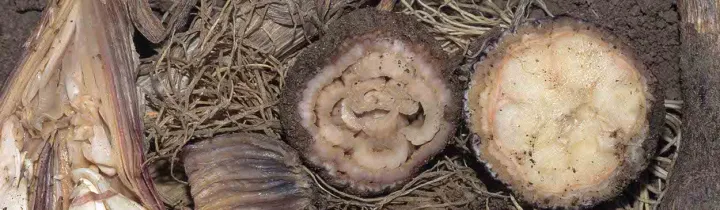
Description
Symptoms
The most distinctive symptom is the development of soft, watery, and mushy scales inside the bulb. Initially, these changes may be limited to one or two layers.
The disease is called "sour skin" because of the characteristic pungent, vinegar-like or sour milk odor emitted by infected bulbs, especially when cut open.
Externally, infected bulbs may appear normal for a long time, while the internal tissues are already rotting. This makes the disease particularly dangerous for commercial storage.
When the bulb is pressed, the internal liquid contents may be squeezed out. The internal layers often take on a pale, yellow, or cream-colored appearance.
The infection usually starts at the neck or the basal plate and spreads downward or upward through the succulent leaf scales, eventually consuming the entire bulb.
Pathogen
The causative agent of sour skin is the bacterium Burkholderia cepacia. It is a widespread soil-borne pathogen known for its ability to survive in organic matter and moist environments.
This disease primarily affects bulb crops such as onions and garlic. It is essentially a post-harvest pathology, meaning it causes the most damage during storage and transit.
The bacteria enter the plant through various openings, including wounds caused by mechanical harvesting, neck tissues that have not healed properly, or the root plate.
Once inside, the bacteria secrete enzymes that decompose the cell walls of the onion scales. This process turns the succulent tissues into a semi-liquid, macerated mass.
The pathogen is highly opportunistic and thrives in environments where host defense mechanisms are weakened, often exploiting harvest-related injuries to establish an infection.
Conditions for development
High humidity is the primary catalyst for Burkholderia cepacia outbreaks. Condensation on bulbs during storage provides the perfect medium for bacterial growth.
Warm temperatures significantly accelerate the rate of bacterial colonization. Storage temperatures above 20°C are highly conducive to rapid spread within a bin.
Inadequate curing (drying) of the onion bulbs after harvest is a major contributing factor. If the neck remains moist, the bacteria enter the bulb with ease.
Heavy rainfall during the harvest season keeps the plants saturated, increasing the initial bacterial load and making the bulbs more susceptible to secondary infections.
Poor airflow and overcrowding in crates lead to the accumulation of moisture and heat, creating "hot spots" where the disease can rapidly transition from one bulb to another.
Why it matters
Sour skin is a devastating post-harvest disease capable of ruining entire batches of stored onions in a short period, leading to massive financial losses.
The infected onions are completely unusable for food or industrial processing. The intense sour odor makes them unacceptable for any culinary use.
The economic burden includes not only the loss of product but also the labor costs associated with manual sorting and disposing of infected produce.
Since the pathogen is soil-borne, it poses a risk for subsequent planting seasons if infected material is not properly managed or if crop rotation is ignored.
The disease spreads stealthily; by the time the odor or external softness is detected, a large portion of the storage unit may already be compromised.
Protection
The most effective strategy is proper curing of the onions after harvest. Ensuring the necks are completely dry is the first line of defense against infection.
Minimize mechanical injuries during harvesting and handling. Every cut or bruise on the onion scale is a potential entry point for Burkholderia cepacia.
Storage facilities should be managed at cool temperatures (near 0-1°C) and low relative humidity (around 65-70%) to inhibit bacterial multiplication.
Implement strict crop rotation practices, avoiding bulb crop production on the same land for at least three to four years to reduce soil inoculum.
Sanitize storage bins and equipment before the new harvest arrives. Removing and destroying infected plant debris from the fields significantly lowers the risk of future outbreaks.
Pathogens and affected parts
Affects crops · 2
Discussion
No discussions yet — be the first.