
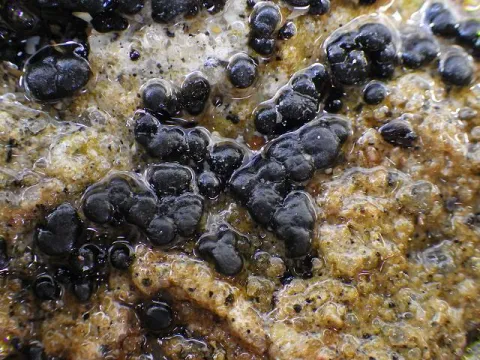
Rivularia atra
Rivularia atra
Rivularia atra is a species of filamentous cyanobacteria known for forming dark, hemispherical colonies. While not a classic pathogen of terrestrial crops, it is a significant nuisance organism in agricultural water management and irrigation systems.
What the section contains
Rivularia atra
The organism consists of radial filaments embedded in a tough, mucilaginous sheath. These colonies grow on submerged surfaces, such as rocks, canal walls, or irrigation infrastructure, where they act as primary colonizers in aquatic environments.
Biologically, it is a photoautotroph that utilizes nitrogen fixation, which allows it to thrive in nitrogen-poor water environments. Its ability to thrive in various light intensities makes it a versatile organism within its ecological niche.
Rivularia belongs to the order Nostocales and is distinguished by the presence of specialized cells called heterocysts. These cells are essential for its metabolic survival, enabling the cyanobacteria to maintain growth under nutrient-limited conditions.
Unlike parasitic fungi, this organism does not directly infect plant tissues. However, its presence indicates specific water quality parameters and environmental conditions that can indirectly impact crop health and infrastructure integrity.
The growth of Rivularia atra is primarily driven by light availability and stable water conditions. It thrives in well-lit environments, including shallow water channels and exposed reservoirs where photosynthesis can occur optimally.
Temperature plays a crucial role, with the species exhibiting peak growth rates in warm water, typically between 20 and 28 degrees Celsius. This makes irrigation systems in temperate and tropical regions particularly vulnerable during summer months.
High nutrient levels, particularly phosphorus and nitrogen, act as a fertilizer for these colonies, triggering rapid proliferation. Eutrophic conditions in irrigation waters often result in a significant increase in colony density.
A neutral to slightly alkaline pH is preferred by the organism. It is often found in areas with high mineral content, where the alkalinity supports the structural integrity of its mucilaginous sheath and metabolic processes.
Stagnant or slow-moving water is ideal for its development. Flowing water usually inhibits the attachment of new colonies, whereas static reservoirs provide the perfect foundation for extensive colonial growth.
The primary harm caused by Rivularia atra is physical clogging. The thick, gelatinous colonies can easily block irrigation nozzles, micro-sprinklers, and inline filters, leading to costly system maintenance and reduced operational efficiency.
In rice paddies, the formation of thick mats on the water surface can restrict oxygen diffusion and block sunlight. This interference negatively affects the growth and development of young crop seedlings during the early stages of cultivation.
The secretion of metabolic by-products into the water can alter the local chemical environment. This change in water chemistry can stress sensitive crops and negatively affect the balance of beneficial soil microflora near the irrigation zones.
Competition for dissolved nutrients in irrigation water is another negative impact. By rapidly consuming nitrogen, the cyanobacteria limit the availability of nutrients that would otherwise be used by the crops.
The secondary ecological impact involves the decay of colonies. When large populations die off, they decompose, which depletes dissolved oxygen in the water, potentially harming aquatic fauna or beneficial organisms within the irrigation circuit.
Effective management begins with mechanical prevention. Regular cleaning of irrigation channels and filters is essential to remove colonies before they reach a stage where they can spread via spores.
Managing nutrient runoff into irrigation water is critical. By reducing the influx of fertilizers and preventing phosphorus loading, the nutrient supply that sustains Rivularia can be significantly curtailed.
Chemical control via algaecides should be used cautiously. Only EPA-approved or locally permitted compounds should be applied, and only if the risk to the main crop and the surrounding ecosystem has been thoroughly assessed.
Increasing water flow or implementing turbulence in storage reservoirs can inhibit the attachment of colonies. Since Rivularia prefers stable surfaces, active water movement is a natural deterrent.
Biological shading, using floating plants or covering systems, can restrict the light available for the cyanobacteria. This simple, sustainable approach significantly reduces the rate of colony formation in agricultural water systems.