
Rickettsioses of plants
Rickettsiales
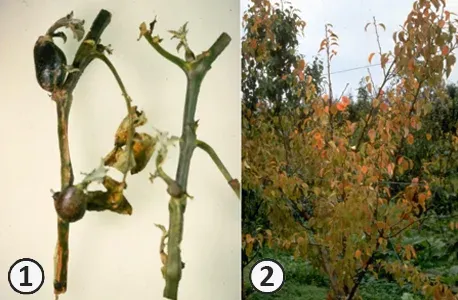
Description
Symptoms
Symptoms of plant rickettsioses often mimic nutrient deficiencies or drought stress, making early detection difficult. The most common signs include marginal leaf yellowing, which progresses to necrosis and leaf scorch.
Stunting is a hallmark of the disease; infected plants show shortened internodes and reduced leaf size. As the infection progresses, the foliage may curl or become distorted, significantly reducing the plant's photosynthetic capacity.
In the reproductive phase, plants exhibit flower drop and fruit abortion. Any fruit that develops is typically stunted, poorly colored, and low in sugar content, rendering it commercially unmarketable.
Internally, the vascular system becomes clogged by the bacterial matrix, obstructing the flow of water and essential nutrients. This physiological starvation causes the plant to wilt and eventually collapse.
Because the pathogens are systemic, symptoms may appear localized initially but will inevitably spread throughout the entire plant, leading to a slow and irreversible decline in health.
Pathogen
Plant rickettsioses are diseases caused by bacteria of the order Rickettsiales, which colonize the xylem or phloem of host plants. These pathogens are obligate intracellular bacteria that cannot survive or reproduce outside the host cell or their specific insect vectors.
These organisms possess a specialized metabolism that relies heavily on nutrients derived from the host plant's vascular system. Unlike typical soil-borne bacteria, they are highly adapted to the internal environment of plant tissues.
Transmission occurs exclusively via insect vectors, primarily leafhoppers, which acquire the bacteria while feeding on infected sap. Mechanical transmission through tools or soil contact is not considered a primary path of spread in field conditions.
The biological cycle of these pathogens is complex and tightly linked to the life cycle of the insect vector. The movement of the bacteria through the plant's vascular network leads to systemic infection, affecting the entire physiology of the host.
A variety of economically important crops are susceptible to these infections, including grapevines, citrus, and various vegetable species, making these pathogens a significant concern for global agriculture.
Conditions for development
The primary factor for disease development is the presence and activity of insect vectors. Warm climates and specific humidity levels favor the reproduction and movement of leafhoppers, triggering outbreaks.
Weed reservoirs are critical for the survival of the pathogen in the absence of a primary host. Many perennial weeds can harbor the bacteria, allowing them to survive through winter and infect new crops in the spring.
A poor or neglected management strategy, which allows the accumulation of insect populations and weeds, significantly increases the risk of transmission. Proactive control of these factors is essential.
Environmental stress, such as water deficit or poor soil drainage, can compromise the plant's structural and physiological integrity, making it easier for the bacteria to colonize and manifest symptoms.
The geographical range of these diseases is limited to areas where the insect vectors can successfully overwinter and sustain active feeding populations throughout the growing season.
Why it matters
The damage caused by plant rickettsioses is severe due to the systemic nature of the infection. Once the vascular tissue is colonized, there is no effective curative treatment for the affected plant.
Infected plantations often suffer from reduced yields, and in many cases, entire plots must be destroyed to prevent the further spread of the bacteria to healthy crops.
These diseases often trigger strict quarantine measures. International and regional movement of plant material from affected areas is heavily regulated to avoid the introduction of the pathogen into new regions.
Beyond yield loss, the quality of the produce is compromised, leading to economic loss for farmers. The metabolic disruption caused by the bacteria renders the produce unfit for consumption or processing.
Persistent infestation of a site by these pathogens can make it impossible to grow certain high-value crops for many years, forcing farmers to choose alternative varieties or move to different locations.
Protection
Integrated Pest Management (IPM) is the most effective approach, focusing primarily on controlling the insect vectors. Regular application of systemic insecticides is vital during periods of vector migration.
Sanitation practices, including the eradication of weeds in and around the fields, are essential to remove the alternate hosts for both the bacteria and the insect vectors.
The use of high-quality, certified pathogen-free nursery stock is the first line of defense. Ensuring that new plantings are not infected from the start is crucial for long-term productivity.
Developing and planting resistant or tolerant cultivars is a long-term goal for many breeding programs. This genetic resistance remains the most sustainable method to combat these vascular diseases.
Continuous monitoring and rapid removal of infected plants allow for the containment of the disease, preventing it from spreading to nearby healthy trees or crops in the field.
Discussion
No discussions yet — be the first.