
Mycoplasma plant diseases
Mycoplasma
The agents of mycoplasma-like diseases are phytoplasmas, specialized gram-negative bacteria that lack a cell wall. They belong to the class Mollicutes and primarily inhabit the phloem tissue of the affected plant.
What the section contains
Mycoplasma plant diseases
These microorganisms are characterized by a very small genome and cell polymorphism, taking spherical, filamentous, or branched forms. Due to the absence of a rigid shell, phytoplasmas are highly sensitive to osmotic pressure and environmental changes.
Phytoplasmas are obligate parasites that require a living host to survive and reproduce. Outside of plant tissues or insect vectors, they die rapidly, which limits their survival in soil or crop residues.
In nature, phytoplasmas circulate between a wide range of plants and specific insect vectors. Their relationship is a form of biological symbiosis, where the insect becomes a lifelong carrier of the infection.
The classification of these pathogens is constantly updated through molecular-genetic methods, specifically 16S rRNA sequencing. This allows for the precise identification of phytoplasma groups causing specific agricultural diseases.
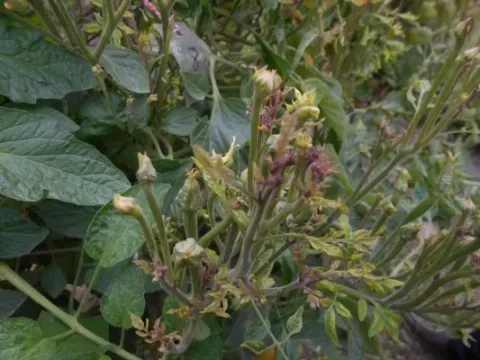
The main signs of mycoplasma-like diseases are systemic developmental changes in plants, often mimicking viral infections. A characteristic symptom is the greening of flower petals (phyllody), where they lose their color and become leaf-like.
Intensive branching occurs, leading to the formation of a "witches' broom," where a large number of shortened, weak shoots grow from the axillary buds. Plants become stunted, with significantly shortened internodes.
Leaves of affected crops often show yellowing (chlorosis) or acquire an anthocyanin coloration, curl at the edges, and become leathery. The root system develops poorly under severe infection, leading to overall plant decline.
Fruits on infected plants may fail to set, or they become deformed, small, and unsuitable for consumption. Fruit trees frequently exhibit premature fruit drop and branch dieback.
Diagnosis through visual methods is difficult due to similarities with nutrient deficiency or viral disease symptoms. PCR testing and microscopic analysis of phloem tissue are essential for accurate identification.
The spread of phytoplasma infections is inextricably linked to the activity of insect vectors, most commonly leafhoppers, planthoppers, and psyllids. These insects are the primary vehicles for transmitting the pathogen from diseased to healthy plants.
The migration of insect vectors during warm seasons promotes the rapid colonization of new territories and the focal spread of diseases in fields. Higher pest population densities lead to more rapid development of epiphytotics.
Warm and dry weather provides favorable conditions for mycoplasma development by stimulating the reproduction and activity of insect vectors. Temperatures ranging from 20 to 28 degrees Celsius are considered optimal for the pathogen to accumulate in plant tissues.
The infectious background is maintained by plant reservoirs, specifically weeds, where vectors hibernate or phytoplasmas persist. Perennial weeds often act as asymptomatic carriers, ensuring the primary infection of crops in the spring.
The presence of weakened plants plays a significant role, as they are more easily infected during insect feeding. Improper nutrition or environmental stress reduces the immune system of crops, making them more susceptible to the pathogen.
Mycoplasma-like diseases cause immense economic damage to agriculture by reducing the yields of vegetable, fruit, and grain crops. In some cases, losses can reach 100 percent, making the cultivation of certain varieties unprofitable.
Infected plants lose the ability to produce a full harvest, and their productivity drops sharply due to metabolic disruption and the blockage of phloem-based nutrient transport. This leads to the exhaustion and eventual death of the plant.
Product quality is compromised as fruits lose their shape, taste, and nutritional value. Affected fields become major sources of infection for neighboring agricultural areas.
Phytoplasmas pose a specific risk to nurseries and seed production. Contaminated planting material, grafts, and seedlings transmit the infection to new regions, making disease management extremely challenging.
A long latent period allows the pathogen to spread unnoticed over significant distances. This often leads to irreversible losses by the time symptoms become obvious to the agronomist.
The primary method for managing these diseases is rigorous phytosanitary control aimed at preventing the introduction of infection into the farm. Using only healthy, certified planting material is the foundation of protection.
Systematic control of insect vectors is necessary, using modern systemic and broad-spectrum insecticides. It is critical to monitor treatment schedules, especially during the peak migration periods of leafhoppers.
Agrotechnical measures include the mandatory destruction of weeds in row spacings and along the field perimeters. Weeds act as natural reservoirs for both the phytoplasma and its insect vectors.
Upon detection of the first symptoms, affected plant specimens should be immediately removed from the field and burned. Leaving diseased plants in the field is strictly prohibited as it creates a permanent source of infection.
- Utilizing resistant crop varieties and hybrids.
- Maintaining proper spatial isolation between different crop plantings.
- Applying preventive insecticide treatments during periods of mass vector flight.