
Bacterial necrosis of papaya
Erwinia papayae
The causative agent of this disease is the phytopathogenic bacterium Erwinia papayae, which belongs to the Enterobacteriaceae family.
What the section contains
Bacterial necrosis of papaya
This microorganism is highly virulent and specifically adapted to attack the vascular tissues and parenchymal cells of papaya plants.
The bacterium is disseminated through mechanical transmission by pruning tools, as well as by rain splash and insect vectors common in tropical regions.
Once inside the host, the pathogen produces enzymes that degrade cell walls, facilitating tissue colonization and systemic infection.
Understanding the molecular biology of Erwinia papayae is crucial for developing resistant cultivars and managing outbreaks effectively.
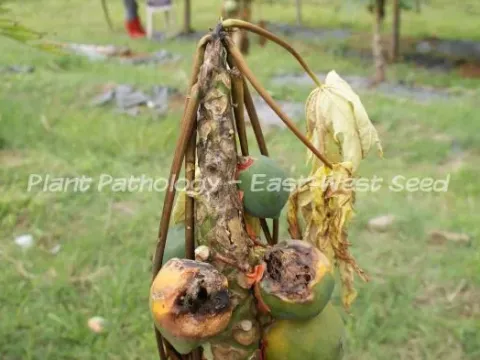
The earliest symptoms include water-soaked spots on the leaves, which rapidly darken and expand, indicating localized tissue necrosis.
Dark, elongated streaks on stems and petioles are characteristic signs, suggesting that the pathogen has entered the plant's vascular system.
Infected fruits develop deep, wet-looking ulcers that may emit a foul odor and lead to premature decay of the entire fruit.
Apical rot often occurs, where the terminal bud dies, leading to the cessation of growth and eventual death of the plant.
Under humid conditions, a bacterial exudate may be visible on the surface of the lesions, serving as a primary source for further spreading the disease.
High relative humidity and frequent rainfall are the primary factors that facilitate the rapid growth and dispersal of the bacterium.
Warm tropical temperatures provide an ideal environment for the pathogen to thrive throughout the entire year without any dormant period.
Physical wounds on the plant caused by pruning, wind damage, or insect feeding provide entry points for the bacteria to infect the tissue.
High-density planting configurations that limit airflow contribute to the persistence of leaf surface moisture, promoting bacterial proliferation.
Poor field sanitation, including the presence of weeds that act as alternate hosts, increases the inoculum potential within the plantation.
Bacterial necrosis is considered a devastating disease for papaya, capable of causing yield losses of up to 90% if not managed properly.
Systemic infection leads to fruit drop and quality deterioration, rendering the crop completely unmarketable and unsuitable for processing.
The disease often necessitates the removal and destruction of entire blocks of trees, causing significant long-term economic losses to farmers.
Management costs increase drastically due to the need for continuous sanitation, tool disinfection, and intensive monitoring of the fields.
Global trade and export opportunities are frequently hindered in regions where the prevalence of Erwinia papayae is high due to quarantine restrictions.
Effective management begins with strict sanitation: infected plants must be uprooted and destroyed immediately upon the detection of symptoms.
Tools used for pruning or maintenance must be rigorously disinfected between plants using appropriate bactericidal solutions to prevent transmission.
Farmers should prioritize the use of disease-free planting material sourced from certified nurseries to prevent the introduction of the pathogen.
Copper-based sprays may be used as a preventive strategy to reduce the bacterial population on the plant surface, although they are not a cure.
- Optimizing tree spacing to improve air circulation and reduce moisture.
- Integrated pest management to control insect vectors.
- Implementing field drainage to prevent water stagnation in the root zone.