
Bacterial necrosis of oak
Lonsdalea quercina
Description
Symptoms
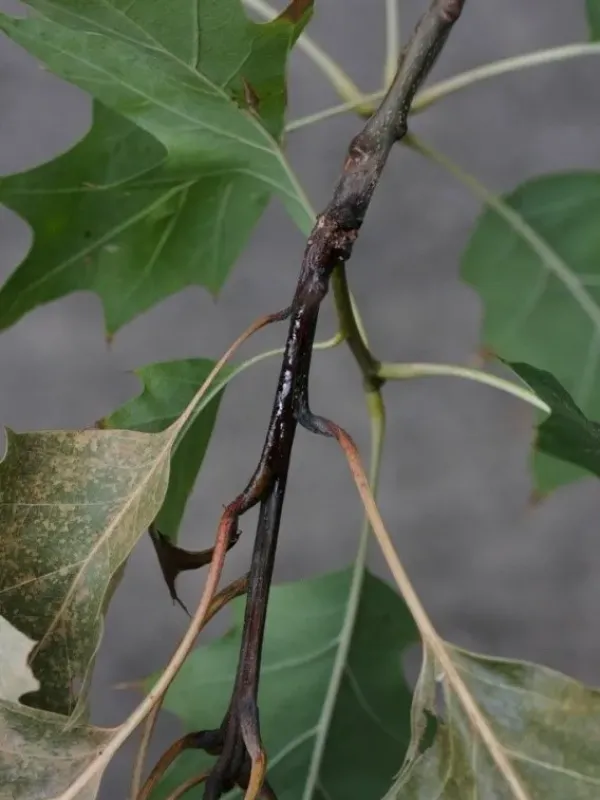
The initial signs of infection appear as localized dark lesions on the bark. These spots are often slightly depressed and may show signs of splitting as the underlying tissue dies.
A hallmark symptom of the disease is the secretion of a viscous, cloudy bacterial ooze (exudate) that leaks from bark cracks. Upon drying, this substance leaves shiny or crusty deposits.
Internal examination of the trunk or branches reveals a characteristic darkening of the cambium and inner bark. The affected areas often emit a foul, putrid odor due to bacterial fermentation.
As the disease progresses and encircles the stem or branch, it interrupts the translocation of water and nutrients, leading to yellowing, wilting, and premature leaf drop in the canopy.
- Bark lesions and cracking
- Bacterial exudate oozing
- Darkening of cambium tissues
- Foul-smelling necrotic areas
- Crown dieback
Pathogen
The causal agent of this disease is the Gram-negative bacterium Lonsdalea quercina, which is a specialized phytopathogen affecting various oak species. It was previously known as Brenneria quercina.
This disease is classified as a bark and cambium bacteriosis. The pathogen colonizes the living tissues of the host, leading to cellular degradation and tissue death.
The bacterium typically enters the tree through wounds, such as frost cracks, pruning sites, or damage caused by boring insects. Once inside, it proliferates in the intercellular spaces.
The secretion of specific enzymes by Lonsdalea quercina is responsible for the rapid breakdown of cell walls, which allows the bacteria to spread through the vascular tissue of the oak.
This pathogen is well-adapted to survive within infected trees and can persist for several seasons, posing a continuous threat to the health of the surrounding forest stand.
Conditions for development
Bacterial necrosis development is highly favored by high humidity and moderate temperatures. These conditions are optimal for the rapid multiplication and spread of the bacterium.
Trees weakened by environmental stressors, such as severe droughts, waterlogging, or cold damage, are significantly more susceptible to infection by Lonsdalea quercina.
Insect vectors play a crucial role in the dissemination of the pathogen. Bark-feeding insects transport the bacteria from infected to healthy trees, effectively spreading the disease.
Stands with high tree density, which exhibit poor air circulation and retain high levels of moisture, are hotspots for the development and transmission of the bacterial pathogen.
Anthropogenic factors, particularly the failure to disinfect pruning tools, can inadvertently introduce the pathogen into previously healthy forest areas or urban parklands.
Why it matters
The damage caused by oak bacterial necrosis is significant, as it can lead to the slow decline and eventual death of both young saplings and mature, ecologically important oak trees.
By killing the cambium, the disease permanently disrupts the tree's vital functions, preventing it from effectively transporting water and nutrients, which eventually leads to total tree failure.
In economic terms, the infection results in the degradation of timber quality, making the wood unsuitable for construction or high-value furniture production.
In public landscapes, infected trees become a safety hazard. As the disease kills large branches, they may snap and fall without warning, posing a danger to people and structures.
The disease can significantly alter forest ecosystems by causing the loss of dominant oak species, which may be replaced by less valuable or non-native tree varieties over time.
Protection
Early detection and monitoring are the most effective ways to manage bacterial necrosis. Regularly inspect trees for bark cracks and the presence of bacterial exudate.
Sanitation is essential; heavily infected trees or branches should be pruned or removed entirely and burned to eliminate the primary source of the inoculum.
Integrated pest management (IPM) should be employed to control wood-boring insects, thereby closing the primary infection pathways that allow the bacterium to enter the tree.
Strict tool hygiene is required. Always disinfect pruning saws, shears, and other equipment with an appropriate antiseptic solution between every tree to prevent cross-contamination.
Promoting overall tree vigor through adequate irrigation during dry spells and proper soil management increases the tree's natural resilience against bacterial pathogens.
Discussion
No discussions yet — be the first.