
Description
Symptoms
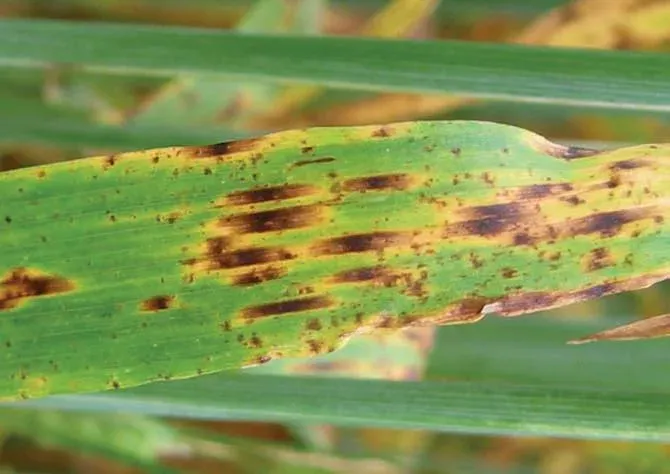
The primary symptom of Ramularia infection is the appearance of small, distinct spots on the leaves. These lesions often begin as chlorotic areas before darkening into a reddish-brown or dark-brown color as the leaf tissue dies.
A distinctive feature of the disease is the presence of a white or grayish powdery growth on the undersides of the leaves. This represents the sporulating structures of the fungus and is most visible under high humidity conditions.
As the infection progresses, individual spots can coalesce to form large necrotic patches. This significantly reduces the functional area of the leaf, leading to yellowing, premature senescence, and ultimately leaf death.
In cereals, the symptoms are most prominent on the upper leaves, including the flag leaf, during the heading and flowering stages. This is the most critical period for grain filling, making the infection particularly damaging.
In severe outbreaks, the fungus may spread to the stem and the glumes of the ear, resulting in a stunted appearance of the crop and reduced grain quality. The entire canopy may exhibit a burned or scorched appearance.
Pathogen
Ramularia leaf spot is a plant disease caused by various species of the Ramularia genus, which are anamorphic fungi. These pathogens are known for causing significant damage to cereal crops, sugar beets, and various legumes.
The most notable species is Ramularia collo-cygni, which is a major concern in barley production globally. These fungi produce conidia that serve as the primary source of infection and spread throughout the growing season.
The life cycle of the pathogen involves the survival of the fungus on crop residues, in the soil, or on infected seed material. From these sources, spores are disseminated to susceptible host plants via wind, water splashes, and physical contact.
Upon landing on a leaf, the fungal spores germinate and penetrate the tissue, typically through stomata or mechanical injuries. The mycelium then develops within the intercellular spaces, extracting nutrients from the host plant.
Microscopic identification of the fungus is essential for accurate diagnosis, as the clinical signs often overlap with other foliar diseases like net blotch or physiological spotting. Proper identification ensures the correct selection of control strategies.
Conditions for development
High relative humidity and frequent rainfall are the most critical factors favoring the development and spread of Ramularia leaf spot. The presence of leaf wetness for extended periods facilitates the germination of spores.
Moderate temperatures ranging from +15°C to +22°C are optimal for the pathogen's growth. These conditions allow the fungus to multiply rapidly, significantly shortening the incubation period of the disease.
Agronomic practices such as high sowing density and excessive nitrogen application create a dense, humid microclimate within the canopy. Such conditions are perfect for fungal colonization and rapid spore dispersal.
Crop residues left on the soil surface in conservation tillage systems act as a reservoir for the fungus. This allows the pathogen to remain in the field and infect the subsequent crop if susceptible varieties are grown.
Physical injuries to the leaves, whether caused by hail, heavy wind, or insect feeding, provide easy entry points for the pathogen. Stress factors, such as drought followed by sudden rain, can also exacerbate the severity of the disease.
Why it matters
The economic impact of Ramularia leaf spot is primarily due to the reduction of photosynthetic efficiency. By destroying green leaf tissue, the disease limits the plant's ability to produce sugars for grain development.
This results in significant losses in grain weight, reduced starch accumulation, and inferior malting or milling quality. Consequently, the market value of the harvested produce is substantially lower.
Plants weakened by Ramularia are more susceptible to secondary infections and environmental stresses. The physiological impact is cumulative, often leading to lodging and increased susceptibility to other pathogens.
In epidemic years, yield losses can range from 20% to over 40% depending on the infection pressure and the cultivar's susceptibility. This makes the disease a major target for intensive crop management programs.
Additionally, farmers face increased costs related to prophylactic or curative fungicide applications. The necessity to control the disease adds a significant burden to the overall cost of production per hectare.
Protection
Effective management of Ramularia leaf spot requires a holistic approach, combining cultural, chemical, and biological controls. Crop rotation is paramount, with a break of at least 2-3 years between susceptible crops.
Managing crop residues through deep tillage or selecting resistant cultivars can reduce the initial inoculum level. Treating seeds with systemic fungicides helps protect the emerging seedlings from early-season infections.
During the growing season, timely fungicide application is the most common control method. Strobilurins and triazoles are frequently used, though monitoring for resistance development is increasingly important.
- Utilize certified disease-free seeds;
- Adopt appropriate crop rotation intervals;
- Optimize plant density to improve air circulation;
- Implement balanced fertilization programs;
- Monitor crops regularly for early symptom detection.
Integrated Pest Management (IPM) strategies emphasize using fungicides only when economic thresholds are likely to be reached. Proper calibration of sprayers ensures deep penetration into the canopy for better disease control.
Content graph
Connections · Ramularia leaf spot
Most often together:
Marketplace
Products · 1
Community
Discussion
No discussions yet — be the first.