
Sunflower downy mildew
Plasmopara halstedii
Description
Symptoms
Symptoms of sunflower downy mildew vary depending on the timing of the infection. Early infection typically manifests as severe stunting, shortened internodes, and thinner stems, making these plants easily identifiable in a field.
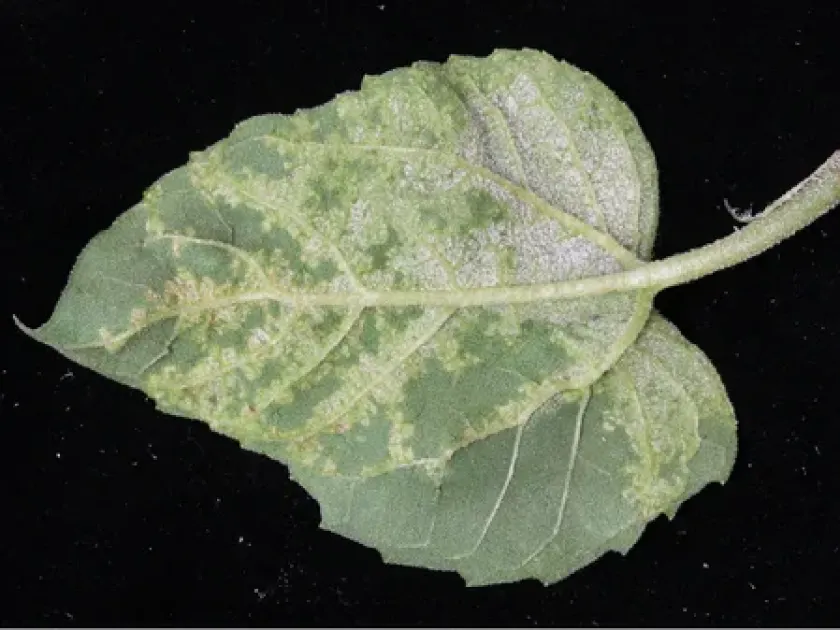
Chlorotic, pale green spots appear on the upper surface of the leaves, often constrained by the leaf veins, giving them an angular appearance. Over time, these leaves lose turgor, turn yellow, and eventually die prematurely.
The most diagnostic sign is the dense, white mycelial growth on the underside of the leaves, corresponding to the chlorotic spots. This fuzzy growth contains conidia that are easily dispersed by wind and rain splashes.
Systemically infected plants often fail to produce normal heads; instead, the heads remain small, underdeveloped, or fail to form entirely. When seeds do form, they are usually empty or have a significantly reduced thousand-kernel weight.
Root system damage leads to a disruption in water and nutrient uptake. Consequently, affected plants often wilt rapidly, particularly during periods of drought, and may die before reaching physiological maturity.
Pathogen
The causal agent of this disease is Plasmopara halstedii, an obligate parasite belonging to the oomycete class. This soil-borne pathogen can remain viable in the form of oospores within soil and crop residues for up to 7–8 years, creating a significant long-term risk.
The disease primarily affects members of the Asteraceae family. Sunflower is the most susceptible host, where the pathogen often causes systemic infection that disrupts the development of the entire plant from the roots to the head.
The life cycle involves the formation of zoospores that travel through water films in the soil to infect young roots. This primary soil-borne infection is the most critical factor determining the overall disease pressure in a field.
This pathogen demonstrates high genetic variability, leading to the continuous emergence of new physiological races. This variability forces breeders to constantly update resistance traits, as older genes often become ineffective against new, virulent strains.
The fungus thrives in cool, wet conditions, which facilitate the rapid spread of zoospores. These spores efficiently locate and infect young plant tissues during the critical early stages of germination and seedling growth.
Conditions for development
High soil moisture is the primary driver for disease development, particularly during seed germination and seedling emergence. Optimal temperatures for infection range between 12 and 18 degrees Celsius.
Prolonged rainfall during the early growing season creates the necessary water films for zoospore movement. Under these conditions, the probability of secondary infections spreading from symptomatic plants increases significantly.
High-density planting creates a microclimate with increased humidity around the foliage. This environment is highly conducive to the spread of secondary spores to the middle and upper leaves, further weakening the crop.
Fields with a history of sunflower cultivation are prone to higher disease levels due to the accumulation of oospores. Heavy clay soils that retain moisture for extended periods provide an ideal environment for pathogen survival.
Agrotechnical mistakes, such as planting in cold, wet soil, delay germination and emergence. This extends the duration of the vulnerable seedling phase, leaving more time for the pathogen to penetrate the roots.
Why it matters
Downy mildew can cause total crop failure if the infection occurs early in the season. Systemically infected plants represent a complete loss of yield, significantly impacting the economic viability of the entire field.
A reduction in seed mass and oil content is a direct consequence of the metabolic disruption caused by the pathogen. Even mild infections lead to substantial financial losses for farmers due to reduced quality and quantity.
Infected plants are often predisposed to secondary infections by other opportunistic pathogens, such as root rots or stalk rots, which further degrade the overall quality of the harvested produce.
In severe cases, fields may require plowing under, leading to direct costs for re-seeding, additional fertilizers, and fuel. This forces a deviation from original farm management plans and reduces seasonal profitability.
The persistence of oospores in the soil necessitates strict adherence to crop rotation. If the pathogen accumulates, sunflower cultivation may become impossible for many years, forcing farmers to abandon the crop on infested land.
Protection
- Planting genetically resistant hybrids that contain modern resistance genes effective against prevalent races of the pathogen.
- Applying systemic fungicides as seed treatments, specifically using compounds known to be effective against oomycetes, such as metalaxyl or mefenoxam.
- Implementing long crop rotations with a minimum gap of 5–7 years between sunflower crops to deplete the oospore population in the soil.
- Strict control of sunflower volunteers, which can act as a bridge for the pathogen to survive and spread throughout the season.
- Optimizing planting dates to ensure that sunflowers grow through their most susceptible stages during periods of warmer, drier weather conditions.
Discussion
No discussions yet — be the first.