

Description
Symptoms
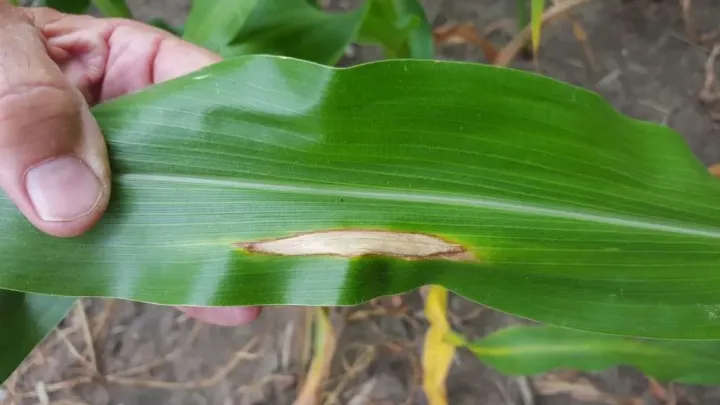
Initial symptoms of NCLB appear as small, water-soaked spots on the lower leaves that gradually expand into long, elliptical, or spindle-shaped lesions.
Mature lesions are typically tan or grayish-green in color, often surrounded by a dark brown border, and can grow up to 15 cm in length.
Under high humidity and moderate temperatures, the centers of these lesions become covered with a dusty, olive-gray to black coating of fungal spores.
As the infection advances, lesions may coalesce, leading to extensive leaf blight and premature death of the entire foliage canopy.
While primarily a foliar disease, in severe cases, the lesions can also appear on the husks and sheaths, reducing overall plant health.
Pathogen
Northern corn leaf blight (NCLB) is caused by the fungus Setosphaeria turcica, which is the teleomorph of the anamorph Exserohilum turcicum.
This fungal pathogen is one of the most widespread and damaging diseases affecting maize production in various agro-climatic zones worldwide.
The fungus overwinters as mycelium and conidia on infected corn debris, remaining viable in the soil for several seasons depending on decomposition rates.
During the growing season, conidia are produced and disseminated by wind and splashing rain to the lower leaves of susceptible corn plants.
The infection process involves the germination of spores and penetration into leaf tissue, leading to the characteristic development of necrotic lesions.
Conditions for development
NCLB development is highly favored by moderate temperatures ranging from 18°C to 27°C, combined with extended periods of moisture and high humidity.
Free moisture on the leaf surface, provided by dew, fog, or frequent rainfall, is essential for the germination of conidia and successful infection.
The disease tends to spread most rapidly when these conditions occur during the silking and grain-filling stages, which are critical for yield formation.
Monoculture cropping systems and minimum tillage practices contribute to higher initial inoculum levels, increasing the risk of early outbreaks.
Dense plant populations and poor field airflow create a favorable microclimate that enhances the secondary spread of the disease across the field.
Why it matters
The primary damage results from the significant reduction in the leaf area available for photosynthesis, directly impacting the crop's yield potential.
Severe infestations can lead to substantial yield losses, sometimes exceeding 50% if the disease reaches the upper leaves before the grain reaches maturity.
Premature leaf loss forces the plant to remobilize nutrients from the stalk to the ear, which often results in weakened stems and increased risk of lodging.
Besides quantity, grain quality can be severely degraded, resulting in smaller, poorly filled kernels and reduced test weight.
Infected crops are also more prone to secondary colonization by stalk rot pathogens, further compounding the losses at the time of harvest.
Protection
The most effective strategy for managing NCLB is the use of resistant or tolerant maize hybrids that can suppress the growth of the fungus.
Cultural practices, such as crop rotation and the incorporation of corn residue through tillage, help to reduce the primary inoculum source significantly.
Fungicide applications are recommended when disease pressure is high, specifically focusing on the period from late vegetative stages to early reproductive stages.
Scouting fields for early symptoms is crucial for timing fungicide applications to maximize their protective effect on the flag leaf and ear leaves.
Balancing nitrogen, phosphorus, and potassium levels helps maintain crop vigor, allowing the plants to better withstand the stress caused by the infection.
In brief
1
Affects crops
Biology
Pathogens and affected parts
Affected plant parts
leaf
Content graph
Affects crops · 1
Content graph
Connections · Northern corn leaf blight
Most often together:
Marketplace
Products · 1
Community
Discussion
No discussions yet — be the first.