
Description
Symptoms
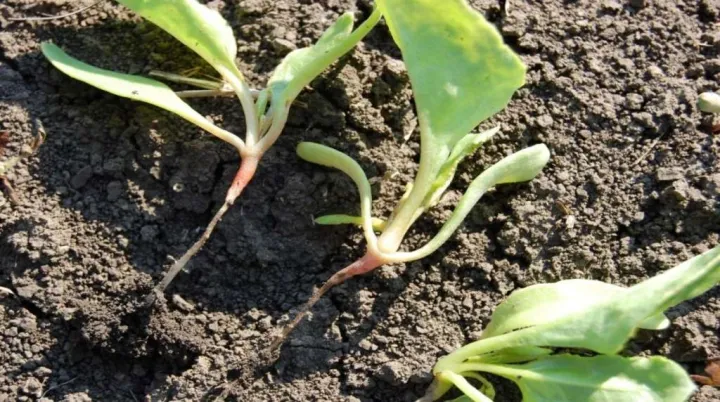
The hallmark symptom is the darkening and thinning of the hypocotyl, which gives the disease its common name, black leg. The affected tissues turn soft and brown, eventually becoming black and necrotic.
In humid conditions, a fuzzy fungal growth may be visible on the surface of the stem. As the tissue rots, the seedling loses its structural integrity and typically topples over or collapses.
Seedlings that are only mildly affected often show stunted growth and wilting. Their root systems are poorly developed, lacking essential root hairs, which prevents them from accessing water and nutrients efficiently.
Affected fields often display uneven stands with patchy areas where seedlings have failed to emerge or have died shortly after emergence. This makes it easy to identify the disease during regular field scouting.
It is important to differentiate between black leg and other stressors, such as herbicide damage or pests, by checking for the characteristic soft rot at the base of the stem.
Pathogen
Beet black leg is a devastating disease affecting seedling stage plants, primarily sugar beets. It is caused by a complex of soil-borne fungi and bacteria, most notably species of Pythium, Phoma, Rhizoctonia, and Fusarium.
These pathogens survive in the soil on crop residues for extended periods, waiting for suitable conditions to infect new hosts. Because the disease involves multiple pathogens, it is often referred to as a disease complex rather than a single infection.
The infection begins when fungal spores penetrate the roots or the hypocotyl of the emerging seedling. The pathogens quickly colonize the tissues, producing enzymes that degrade plant cells.
Different pathogens may dominate depending on the specific soil type, moisture levels, and temperature. This diversity makes the disease persistent and difficult to eradicate from affected fields completely.
Seedlings are susceptible from the moment of germination until the development of several true leaves. Once the stem thickens and becomes lignified, the plant gains natural resistance to these pathogens.
Conditions for development
Development of black leg is highly favored by cool, wet soil conditions. Cold springs delay seedling growth, leaving them vulnerable to fungal invasion for a longer period of time.
Soil compaction and the formation of a soil crust can significantly worsen the disease. Poor aeration restricts oxygen availability to the roots, which weakens the plant and promotes fungal proliferation.
Excessive nitrogen fertilizer can produce succulent tissues that are easily penetrated by pathogens. Conversely, a deficiency in phosphorus and other key nutrients can impair the natural defense mechanisms of the young plant.
Acidic soil environments tend to support higher activity of pathogens like Aphanomyces, a common component of the black leg complex. Proper soil pH management is therefore essential for mitigating risk.
Poor field hygiene, including the presence of crop residues from previous host plants and high weed pressure, creates an environment where pathogens can easily spread and multiply.
Why it matters
The primary harm caused by black leg is the loss of stand density, which directly impacts yield potential. In severe cases, total crop loss occurs, requiring expensive replanting operations.
Even when plants survive, they often exhibit reduced vigor and yield lower quality roots. The uneven development makes subsequent field operations, such as thinning or weeding, much more difficult.
Plants that recover from the disease are often prone to late-season secondary infections, which can affect the storage quality of the roots. This leads to substantial post-harvest losses if not managed correctly.
Economic losses arise not only from reduced tonnage but also from the increased input costs required to manage the disease across large areas. It remains a major concern for commercial sugar beet growers.
The disease acts as a limiting factor in production, especially in regions with frequent cold and rainy springs. Consistent monitoring is necessary to minimize the impact of this disease.
Protection
Using high-quality, fungicide-treated seeds is the most effective way to protect seedlings during the critical early stages of development. Chemical seed treatments provide a barrier against soil-borne pathogens.
Implementing a proper crop rotation plan is crucial. Avoiding the planting of sugar beets in fields where host crops were previously grown helps reduce the population of soil-borne pathogens.
Improving soil structure through proper tillage helps avoid crusting and ensures good drainage. This allows for faster warming of the soil, promoting rapid and uniform emergence of the crop.
Maintaining a balanced nutrient program, particularly ensuring adequate phosphorus levels, helps strengthen seedlings. Liming the soil to adjust pH levels is also a recommended strategy.
Key management practices include:
- Ensuring optimal planting depth.
- Avoiding planting in cold, waterlogged soils.
- Controlling weeds that may harbor pathogens.
- Choosing resistant or tolerant varieties when available.
Content graph
Connections · Beet black leg
Most often together:
Marketplace
Products · 20
All 20
Sugar Beet 307
Fungicides 20
Feed Beet 16
Insecticides, Acaricides 2
Tulips 2
Lettuce 2
Biological Products 1
Table Beet 1
Stevia 1


Forsaj 500 SC
China Chemical Industrial & Rice Co. Ltd
Fungicides
0
0
·
1.5K
1 offer
8.35 €per 1 l
Buy

Lametil WP
Nanjing No.1 Pesticide Factory of Red Sun Group Co., Ltd.
Fungicides
0
0
·
1.4K
2 offers
1.78 €per 1 l
Buy



Royalflor 48% w.s.
Кеитура Корпорейшн С.р.л., Італія
Fungicides
0
0
·
51
2 offers
11.62 €per 1 l
Buy

Apron XL 350 FS
Сингента Агро С.А.С., Сант Пьер ла Гарен, Франція
Fungicides
0
0
·
44
1 offer
142.26 €per pack
Buy


PROPHYLACTIC, ZP
«Нанджин Ессенс Файн-Кемікал Ко. Лтд» (Китай)
Fungicides
0
0
·
31
2 offers
159.77 €per 1 l
Buy


Composite
Nanjing No.1 Pesticide Factory of Red Sun Group Co., Ltd.
Fungicides
0
0
·
151
No offers
—
Details


Community
Discussion
No discussions yet — be the first.