

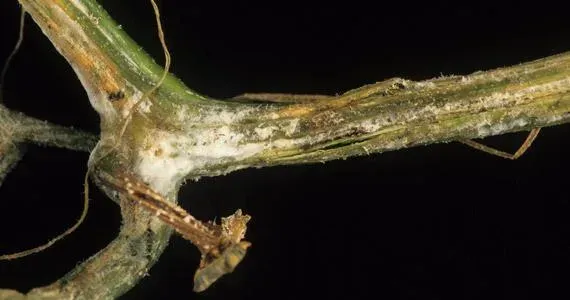
Description
Symptoms
Initial symptoms often include yellowing of the foliage and stunting of the plant. Infected plants show a gradual loss of vigor, followed by wilting that becomes permanent as the root system decays.
Examination of the roots reveals browning, rotting, and tissue degradation. The roots lose their fine structure and the plant becomes easily dislodged from the soil.
A cross-section of the crown or the base of the stem frequently shows dark-red or purple-brown discoloration in the vascular tissues, which is a hallmark sign of this infection.
Under high humidity conditions, a white or light pink fungal mycelium may develop on the crown or the stem base near the soil line.
- Foliar yellowing and premature wilting
- Browning and decay of the root system
- Vascular discoloration inside the crown
- Stunting and plant death
Pathogen
The disease is caused by the fungus Gibberella fujikuroi (anamorph: Fusarium moniliforme). It is a highly persistent soil-borne pathogen that belongs to the Ascomycota phylum.
The fungus survives in the soil and on plant debris as thick-walled chlamydospores, which allow it to remain viable for several years. It can also be transmitted via contaminated seeds or infected vegetative planting material.
Gibberella fujikuroi spreads through the production of microconidia and macroconidia, which can be moved by irrigation water, farm machinery, and wind, facilitating rapid spread within a field.
The fungus produces various mycotoxins that interfere with the plant's vascular transport system. This leads to the characteristic wilting and necrosis observed in infected host plants.
This pathogen has a wide host range, infecting many crops including cereals and vegetables. Asparagus is particularly susceptible, as the fungus targets the crown and fibrous roots.
Conditions for development
Fusarium root rot development is highly dependent on environmental conditions, particularly soil temperature. The fungus thrives at temperatures ranging from +20°C to +30°C.
Excessive soil moisture and poor drainage significantly exacerbate the disease. Saturated soils create anaerobic conditions that favor fungal colonization of the roots.
Plants under physiological stress—due to nutrient deficiency, insect damage, or poor site selection—are far more susceptible to infection by Gibberella fujikuroi.
Continuous cropping of susceptible species leads to a significant increase in the inoculum level in the soil, making future outbreaks more likely and severe.
In acidic soils, the fungus exhibits higher activity and aggressiveness, which is a critical factor to manage in production fields.
Why it matters
The damage caused by Fusarium crown rot is severe, often resulting in significant plant mortality. In asparagus production, it leads to uneven stands and permanent yield loss.
The pathogen destroys the plant's ability to store nutrients, leading to a steady decline in the productivity of perennials over successive seasons.
Besides yield loss, the infection lowers the quality of the harvested product, as the accumulation of mycotoxins in plant tissues can pose health risks.
The disease also makes crops more vulnerable to secondary infections, further reducing the overall health and longevity of the planting.
Large-scale infestations often require complete removal and destruction of the infected crop, resulting in substantial financial losses for growers.
Protection
The primary control strategy is crop rotation with non-host species, usually for a period of at least 4-5 years, to reduce the pathogen population in the soil.
Ensuring good soil drainage is essential. Growers should avoid over-irrigation and choose fields with well-aerated, fertile soil to prevent root suffocation.
The use of healthy, disease-free transplants or crowns is vital. Fungicidal dips for planting material can provide a protective barrier against early infection.
Biological control agents, specifically Trichoderma species, are effective in colonizing the rhizosphere and suppressing the growth of Fusarium fungi.
Integrated management should also include optimal fertilization and pH adjustment to maintain strong plant vigor, as healthy plants can better resist infection.
In brief
1
Affects crops
Biology
Pathogens and affected parts
Affected plant parts
root
Content graph
Affects crops · 1
Content graph
Connections · Fusarium crown and root rot
Most often together:
Marketplace
Products · 3

Community
Discussion
No discussions yet — be the first.