

Description
Symptoms
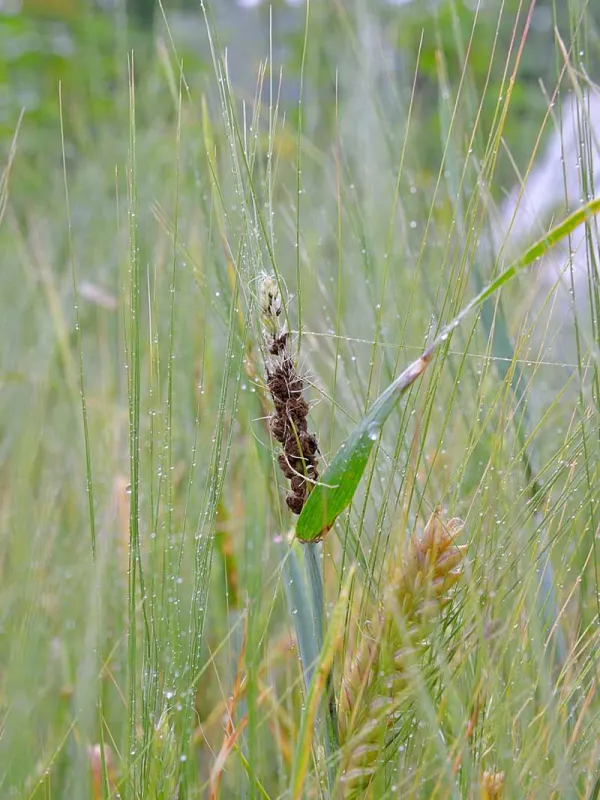
The primary symptom of the disease is the appearance of long, narrow stripes or blisters on the leaves and leaf sheaths. Initially, these are covered by the plant epidermis, which eventually ruptures to release a black, powdery mass of fungal spores.
Plants affected by this pathogen often look stunted and exhibit increased tillering, but they remain significantly shorter than healthy plants. Stems frequently become twisted and deformed, a characteristic feature observable during the booting and heading stages.
In most severe cases, infected plants fail to produce a normal grain head. Even if ears do develop, they often remain sterile, distorted, and empty, rendering the affected plants biologically unproductive.
A distinctive feature of flag smut is the alignment of spore-filled stripes parallel to the leaf veins. Under heavy infection pressure, the leaves and stems may shred or wither prematurely in the field.
The disease usually occurs in localized patches. When scouting fields, it is important to identify these groups of deformed plants, as they stand out against the backdrop of healthy crop growth.
Pathogen
The causal agent of flag smut is a specialized fungus called Urocystis agropyri, which belongs to the Basidiomycota phylum. It is an obligate parasite with a narrow host range restricted to specific cereal crops.
The fungus survives in the soil and on seed surfaces as teliospores, which are grouped into dense spore balls. These structures are highly resistant to environmental stressors and can persist in the soil for several years.
The infection cycle begins during seed germination. The pathogen infects the young seedling through the coleoptile, after which the mycelium spreads systemically throughout the plant’s internal tissues.
The fungus develops internally, sequestering nutrients from the host plant. As the crop matures, the parasite produces its spores within the tissues of the stem and leaves, completing its lifecycle.
The biology of the pathogen is closely synchronized with the growth stages of winter wheat. Infection progresses in tandem with the plant, with spore production peaking during the grain-filling or milk stage.
Conditions for development
Disease development is favored by cool and moist weather conditions during the seedling emergence period. The optimal temperature range for infection typically falls between +10°C and +20°C.
Infection is most successful when seeds are planted shallowly, as the young seedlings remain in the vulnerable stage for a longer duration. Planting at proper depths in warmer soil can help reduce the rate of infection.
Soil type plays a role in disease prevalence; heavy, poorly drained soils often increase the risk of pathogen spread. Since the soil is a primary reservoir, crop rotation is crucial for management.
Soil pH can influence the germination rate of fungal spores in the root zone. Favorable conditions for the disease are created through the continuous cultivation of susceptible wheat varieties in the same field.
Weather conditions at the time of emergence determine the severity of the outbreak. If dry conditions prevail during this critical window, the activity of the pathogen is inhibited, protecting the crop from potential epidemics.
Why it matters
The primary economic impact of flag smut is the loss of productive tillers, which leads to a direct reduction in grain yield. Infected plants contribute little to nothing to the total harvest.
The disease significantly weakens the plant's natural defenses. Beyond direct yield losses, there is a decline in biomass quality and a reduction in the overall stand density of the wheat crop.
The inoculum load in the field increases every year if proper agronomic practices are not followed. This makes it difficult to achieve high yields in the future on infested land.
Infected plants exhibit poor overwintering capacity if initial colonization occurs in the autumn. This leads to sparse stands, and the remaining healthy plants are often unable to compensate for the missing yield.
Economic losses include the costs of replanting, the total loss of grain from infected areas, and the increased investment required for chemical soil and seed disinfection.
Protection
The primary management strategy is the use of high-quality, treated seed. Systemic fungicides are highly effective at suppressing fungal spores present on the surface of the seed.
Crop rotation is mandatory for effective control. It is recommended to avoid planting wheat in the same field for at least 3–4 years to allow soil-borne spores to lose their viability.
Agronomic practices, such as choosing optimal planting dates, help seedlings pass through the susceptible window quickly. Avoid planting in excessively cold and damp soil conditions.
Selecting resistant cultivars is the most sustainable approach. Breeding programs continue to focus on genetic resistance to Urocystis agropyri to mitigate the threat of this pathogen.
- Utilize certified, pathogen-free seed sources.
- Plant at appropriate depths to ensure rapid seedling emergence.
- Apply systemic seed treatments before planting.
- Remove and destroy volunteer wheat plants in the field.
- Optimize soil fertility to improve overall plant health and vigor.
In brief
1
Affects crops
Biology
Pathogens and affected parts
Pathogens
Affected plant parts
whole plant
Content graph
Affects crops · 1
Content graph
Connections · Flag smut
Most often together:
Marketplace
Products · 1
Community
Discussion
No discussions yet — be the first.