

Description
Symptoms
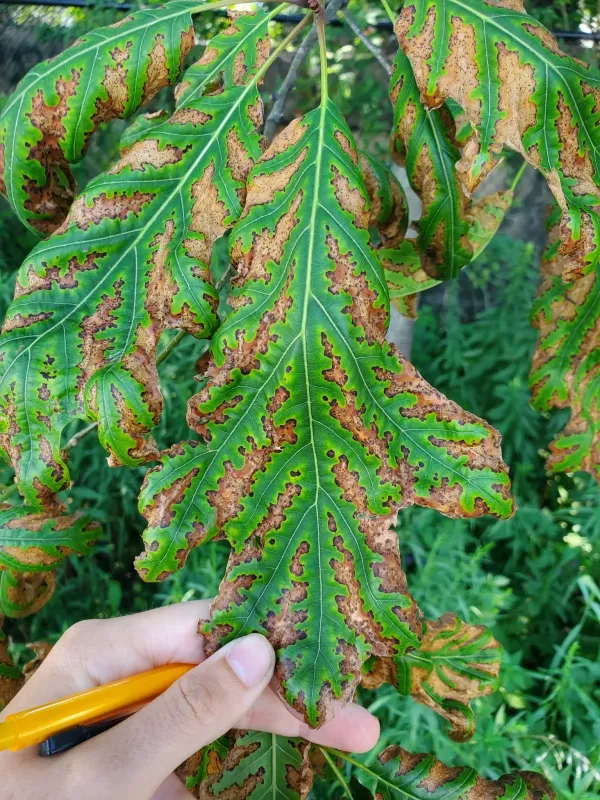
The most common initial symptom is the marginal leaf necrosis, where the edges of leaves turn brown while the tissue near the veins remains green.
Affected vines often display irregular cane maturation, leaving patches of green, succulent tissue that are highly susceptible to frost damage.
Fruit clusters on infected plants often shrivel, dry out, or drop prematurely, leading to significant yield losses before the harvest can take place.
As the disease progresses, the plant experiences a general decline, with foliage dropping and leaving behind bare leaf petioles still attached to the shoots.
In later stages, the vine begins to die back, and eventually, the entire plant succumbs to water stress as the vascular system becomes completely blocked.
Pathogen
Pierce's disease is caused by the bacterium Xylella fastidiosa, which is a plant pathogen that resides specifically in the xylem vessels.
The bacteria colonize the xylem, creating biofilms that physically obstruct the movement of water and dissolved minerals throughout the plant vascular system.
The pathogen has an exceptionally broad host range, infecting not only grapevines but also almond trees, citrus, olives, and many ornamental plants.
Transmission occurs primarily through xylem-feeding insects, most notably sharpshooters, which acquire the bacteria while feeding on infected plant tissues.
Xylella fastidiosa is known for its ability to persist in various weed species and host plants, allowing it to survive in the environment and re-emerge in vineyards.
Conditions for development
The spread of the disease is heavily influenced by the climate, as warmer winters favor the survival and population growth of insect vectors like sharpshooters.
The presence of alternative host plants and weeds near vineyard borders provides a continuous reservoir of infection for incoming insect populations.
Optimal environmental conditions for insect vector activity include moderate temperatures and humidity, which maximize their feeding and mobility.
Movement of nursery stock is a critical factor; because the bacteria can exist in an asymptomatic state, infected plants are easily transported across regions.
The proximity of vineyards to wild or riparian habitats increases the risk of infestation, as these areas often host large populations of native insect vectors.
Why it matters
Pierce's disease is fatal to grapevines, and there is currently no cure, making it one of the most destructive threats in viticulture.
The infection forces growers to remove infected vines and replant entire sections of the vineyard, leading to substantial economic and time losses.
Water stress caused by the bacterial blockage impacts the vine's ability to maintain photosynthesis, rapidly weakening its structural integrity.
Due to its high danger, many countries place the pathogen under strict quarantine, which restricts the movement of plants and related agricultural materials.
The impact is felt most severely by the wine industry, as the disease can decimate high-value vineyards that produce premium quality grapes.
Protection
Prevention relies heavily on stringent phytosanitary measures, including the use of certified disease-free nursery stock to avoid introducing the pathogen.
Integrated Pest Management (IPM) is crucial, focusing on the reduction of insect vector populations through timely and selective insecticide applications.
Cultural practices such as removing host weeds and maintaining a clean vineyard floor help to minimize the attractiveness of the area to insect vectors.
Early detection and immediate removal of symptomatic vines are essential to limit the localized spread of the bacteria to neighboring healthy plants.
Ongoing research into breeding resistant rootstocks and host-plant immunity offers the most promising long-term solution to living with this bacterial pathogen.
In brief
1
Affects crops
Biology
Pathogens and affected parts
Content graph
Affects crops · 1
Content graph
Connections · Pierce's disease
Most often together:
Marketplace
Products · 1
Community
Discussion
No discussions yet — be the first.