
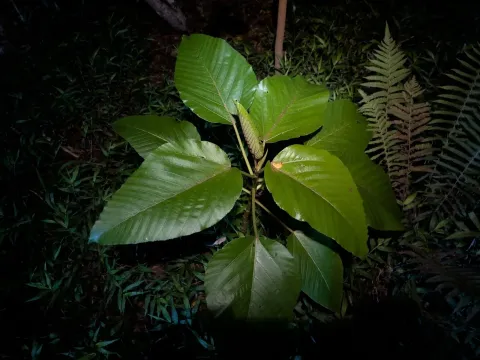
Touchardia
Touchardia
Touchardia, known botanically as Touchardia latifolia, is a shrub belonging to the Urticaceae family. It is endemic to the Hawaiian Islands and holds a significant place in indigenous culture as the primary source of the legendary Olona fiber.
What the section contains

Touchardia
The plant thrives in moist, high-rainfall environments, typically found in the understory of Hawaiian rainforests. It requires consistently high humidity and well-drained, nutrient-rich volcanic soils to reach its full development potential.
Regarding climate, Touchardia is strictly tropical and sensitive to cold temperatures or drought conditions. It performs best in sheltered locations where it is protected from strong, drying winds that can cause leaf damage and stunted growth.
Agricultural management of this crop involves maintaining soil fertility through organic mulching, which mimics the natural forest floor conditions. Proper spacing is essential to ensure adequate airflow and prevent the development of pathogens within the foliage.
The propagation of the plant is primarily carried out through vegetative cuttings, as seedling establishment can be slow and unreliable under field conditions. This method ensures the preservation of fiber quality and morphological uniformity across the plantation.
The harvesting of Touchardia is focused on the stems, which contain the valuable bast fibers. Harvesters select mature stems that have reached the appropriate diameter to ensure the extraction of the strongest and most durable fiber strands.
Once the stems are harvested, the bark is carefully stripped away from the woody inner core. This process, known as decortication, must be performed with precision to avoid damaging the delicate, long fiber bundles that characterize the high-quality Olona.
The extracted fibers are then processed through washing and scraping to remove remaining plant tissues. The resulting material is renowned globally for its extreme tensile strength and remarkable resistance to degradation in salt water.
Historically, the processed fibers were twisted into cordage and ropes used for fishing nets and outrigger canoes. The unique combination of durability and flexibility makes Olona one of the finest natural fibers ever utilized by humans.
Sustainable harvesting involves selectively cutting only a portion of the stems, allowing the mother plant to produce new shoots. This systematic approach supports long-term productivity and maintains the ecological health of the growing site.