
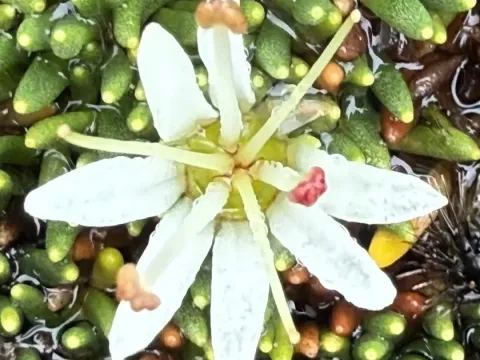
Donatia
Donatia
The genus Donatia belongs to the Donatiaceae family. These are low-growing, cushion-forming perennials that have adapted to the severe conditions of high-altitude regions and southern latitudes.
What the section contains

Donatia
In its natural habitat, Donatia fascicularis is found in subantarctic regions of Chile and Argentina, as well as Tasmania and New Zealand. The plants form dense, compact mats that help retain heat and protect against harsh winds.
This crop requires specific conditions that closely mimic tundra or alpine environments. It prefers a cool climate, high atmospheric humidity, and excellent soil drainage, as waterlogging is detrimental to its root system.
The soil must be acidic, low in nutrients, and often rocky or peaty. In agricultural practice, this plant is not a commercial crop and is primarily significant for botanical research and specialized alpine collections.
Cultivation is extremely challenging due to the slow growth rate and high sensitivity to summer overheating. The plant requires constant fresh air circulation and stability in root zone temperatures to survive.
The primary threats to the plant in cultivation are fungal infections, which typically occur when air circulation is poor or when the growing medium is kept excessively wet.
While the plant rarely encounters specific pests in its native habitat, greenhouse-grown specimens may be susceptible to spider mites or mealybugs under stress.
The application of nitrogen-rich fertilizers is highly discouraged, as it leads to etiolated, weak growth that ruins the plant's characteristic dense cushion morphology.
Climate change and rising temperatures in native highland regions pose a long-term threat to the survival of these species, as they lack the plasticity for rapid environmental adaptation.
To ensure plant health, it is recommended to protect the foliage from intense midday sun and to irrigate only with soft, slightly acidified water to maintain the required soil chemistry.