
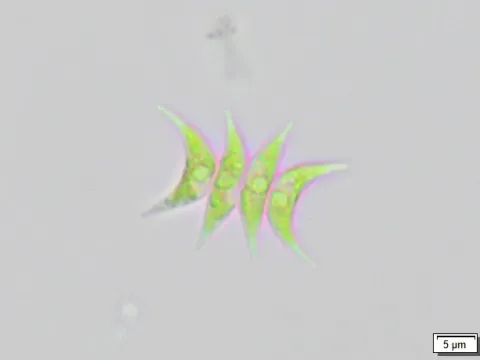
Tetradesmus
Tetradesmus
Tetradesmus is a genus of green microalgae belonging to the family Scenedesmaceae. In agricultural and industrial settings, cultivation begins with the inoculation of a sterilized nutrient medium with a pure strain in controlled laboratory conditions.
What the section contains

Tetradesmus
The timing of the initial inoculation is determined by the need to maintain a consistent temperature regime. In enclosed photo-bioreactors, cultivation can occur continuously throughout the year.
The process requires an adaptation phase where the algae adjust to the specific nutrient composition, typically enriched with nitrogen, phosphorus, and trace minerals to promote biomass doubling.
Inoculation density is a critical factor for successful propagation. Maintaining a specific cell count ensures that the lag phase is minimized and exponential growth is achieved rapidly.
Biological plasticity allows Tetradesmus to be managed for different products, switching from high biomass growth to high lipid synthesis by adjusting the nutrient balance.
Light intensity is the primary requirement for Tetradesmus, as it is a photoautotrophic organism. Optimized light cycles are necessary to maximize chlorophyll synthesis and photosynthetic efficiency.
The ideal temperature range for metabolic activity is 20 to 30 degrees Celsius. Extreme temperatures outside this range inhibit cell division and may lead to culture collapse.
Maintaining a stable pH, typically between 7.0 and 8.5, is essential. This is achieved by precise carbon dioxide injection, which serves both as a pH buffer and as a carbon source.
Water quality must be strictly monitored to prevent contamination by heavy metals or chemicals that could be toxic to the algal cells.
Constant agitation is required to prevent cell settling and to ensure that all cells have equal access to nutrients and light, which is critical in high-density culture systems.
Under optimized conditions, Tetradesmus is known for its high productivity. It demonstrates rapid biomass accumulation, making it a competitive candidate for industrial-scale cultivation.
The yield depends heavily on the efficiency of the CO2 delivery system and the availability of essential minerals. Enhanced setups can significantly increase the total harvest volume.
The main commercial application for Tetradesmus is the production of lipids for biofuels. By inducing nutrient stress, growers can increase lipid content, making it an efficient feedstock.
Beyond biofuels, the biomass serves as a vital component in aquaculture feed due to its high protein and pigment content, which supports the health of aquatic organisms.
Success in yield is predicated on maintaining a monoculture; any presence of contaminants or invasive species can drastically reduce the final output.
The most significant biological threat to Tetradesmus cultivation is predation by zooplankton, such as rotifers or protozoa, which can decimate a culture within hours.
Invasive microalgae species can outcompete the target strain for nutrients and light. Strict sanitation protocols are required to avoid contamination in open or semi-open systems.
Viral infections specific to green algae can lead to mass cell lysis. Prevention involves regular strain refreshing and rigorous cleaning of the reactor surfaces.
Environmental stress, such as sudden fluctuations in nutrient availability or light levels, can trigger physiological degradation in the culture.
- Zooplankton grazing.
- Bacterial and fungal pathogens.
- Invasive algae competition.
- Light stress and photoinhibition.
Harvesting the biomass involves concentration, typically achieved through centrifugation, which is the most reliable method for high-purity yield extraction.
Flocculation using food-grade chemicals is an alternative for large-scale operations to reduce the high energy costs associated with mechanical centrifugation.
Once harvested, the biomass is usually processed into a paste or dried for storage. This step is crucial to stabilize the organic content for downstream lipid or protein extraction.
The timing of the harvest is strategically managed: early for peak protein content or delayed to allow the culture to reach its maximum lipid accumulation phase.
The leftover water, after nutrient supplementation, can be recycled back into the growth system, reducing waste and improving the overall sustainability of the process.