
Tetradesmus obliquus
Tetradesmus obliquus
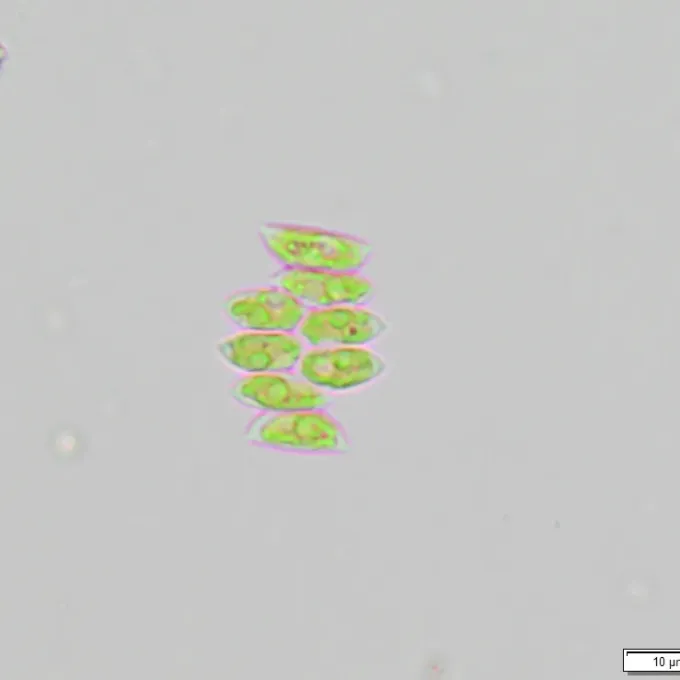
Description
Sowing dates
Industrial cultivation of Tetradesmus obliquus does not involve "sowing" in the traditional agronomic sense. Instead, the process begins with the inoculation of bioreactors or open ponds with a pure culture of the algae.
The optimal time to start the process in open systems is when the average daily water temperature stabilizes above 15–20 degrees Celsius. It is crucial to maintain proper seeding density to prevent the development of dominant strains of other species.
In closed photobioreactors, inoculation is carried out year-round while maintaining a constant temperature regime. The initial cell concentration should ensure the culture quickly enters the exponential growth phase.
The inoculation process requires strict adherence to sterility, especially in the early stages, to avoid contamination by protozoa or other microalgae. Specialized growth media such as BG-11 or their analogs are typically used.
Monitoring the sowing process involves regular microscopic cell counting and assessment of the optical density of the medium. Once the target biomass is reached, it is gradually scaled up to the working volumes of the reactor.
Growing requirements
Tetradesmus obliquus belongs to the Scenedesmaceae family and is a freshwater green microalga. It exhibits high tolerance to various light levels, though it grows most intensely under bright sunlight or artificial lighting within the 400–700 nm spectrum.
For normal development, the culture requires carbon dioxide, which is supplied to the system to support photosynthesis. The optimal pH level of the medium ranges from 7.0 to 8.5, which facilitates the uptake of mineral substances.
Mineral nutrition includes nitrogen, phosphorus, potassium, and trace elements, which must be present in the medium in balanced proportions. A shortage of nutrients triggers the accumulation of lipids or carbohydrates in the cells, which is often a goal for biochemical production.
The temperature range for growth is between 18 and 30 degrees Celsius. Temperatures above 35 degrees can be critical and lead to population degradation unless forced cooling of the system is provided.
Water requirements include the absence of toxic impurities and heavy metals, which can inhibit the photosynthetic activity of the cells. In industrial conditions, recirculating water systems with constant purification are often used.
Yield
The yield of Tetradesmus obliquus is assessed by the dry weight of the biomass obtained per unit of volume or area of the cultivator over a specific period. Under optimized conditions, productivity can reach 0.2–0.5 grams per liter per day.
In open water bodies, yield is lower and heavily dependent on weather conditions, averaging 10–20 tons of dry matter per hectare per year. The use of closed photobioreactors allows this figure to be increased several times over.
Biomass output depends directly on the efficiency of CO2 supply and the stirring speed of the suspension. Turbulence in the medium prevents cell settling and ensures uniform light energy distribution for each cell.
The chemical composition of the biomass makes it a valuable raw material, containing up to 30-40% protein and a significant amount of lipids. These parameters define the economic viability of cultivating this crop.
Maximum product yield is achieved when entering the "stationary phase" of growth, where cell division slows down and the accumulation of secondary metabolites reaches its peak. Immediate harvesting is required thereafter to maintain high product quality.
Main diseases and pests
A major threat to Tetradesmus obliquus plantations is invasion by predatory protozoa (ciliates, rotifers), which can destroy the culture in just a few days. This is a critical issue for open systems.
Bacterial contamination of the medium often leads to a decrease in growth rate due to competition for nutrients. Preventive sterilization methods are applied to combat pathogenic microflora.
Viral infections of microalgae are less common but can cause mass lysis of cells within the population. This necessitates periodic strain rotation and disinfection of all equipment.
Competition from other algae species (e.g., Chlorella or cyanobacteria) can lead to the displacement of the target culture. Maintaining specific pH and salinity conditions in the medium is a key protection method.
Physical factors, such as overheating or overexposure to light, can also cause stress to the culture, triggering photoinhibition. Automated system control minimizes the risks of biomass loss.
Harvesting
Harvesting is carried out by separating the biomass from the culture liquid using centrifugation, flocculation, or filtration methods. The choice of method depends on the density of the culture and the required degree of purity.
Centrifugation is the most effective but energy-intensive method, ensuring the production of a thick paste. It is used primarily when dealing with high-value components for the pharmaceutical industry.
Flocculation using specialized reagents allows for the aggregation of cells for subsequent settling. This is a cheaper method suitable for large-scale production of feed additives.
After harvesting, the biomass is subjected to drying (usually spray or drum drying), which allows for long-term product storage. The dry mass retains its nutritional properties for a long period under proper storage conditions.
The resulting raw material is used in the food industry, aquaculture (as feed for fish and mollusk larvae), and the biofuel industry. Secondary metabolites of Tetradesmus obliquus are of particular interest for cosmetics.