
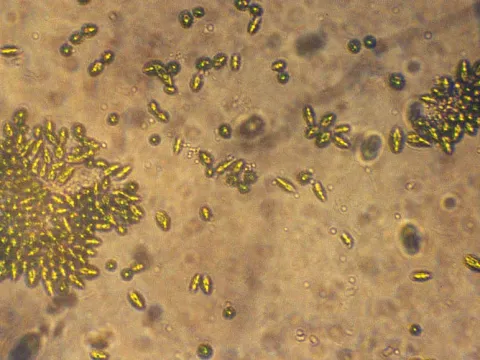
Pyramimonas
Pyramimonas
Pyramimonas is a genus of unicellular green algae belonging to the family Pyramimonadaceae within the class Pyramimonadophyceae. These organisms are recognized for their distinct cell morphology and presence of organic scales on the cell surface.
What the section contains

Pyramimonas
These microalgae are key contributors to the primary production in marine ecosystems worldwide. They thrive in various environments ranging from polar regions to temperate coastal zones, demonstrating high adaptability to different light regimes.
Cultivation requirements involve maintaining precise salinity and nutrient concentrations. Standard culture media must include necessary nitrogen, phosphorus, and trace elements to support healthy cell division rates.
Temperature control is crucial, as Pyramimonas species generally prefer cool to moderate water conditions. Excessive heat can cause cell lysis and total loss of the culture in a laboratory or industrial setting.
Active motility provided by four flagella requires the cells to be kept in suspension. Constant aeration or stirring is necessary to ensure uniform nutrient distribution and prevent cell aggregation at the bottom of the vessel.
In terms of agricultural and aquaculture use, Pyramimonas is highly valued as a high-quality live feed for larval stages of shellfish and crustaceans. It provides essential lipids and amino acids.
The yield of Pyramimonas is calculated as the final cell density per liter. Achieving high yields is dependent on the optimization of the light-to-dark cycle and the precise supply of CO2 for carbon fixation.
Beyond live feed applications, research into Pyramimonas as a source of bioactive compounds is expanding. These compounds have potential therapeutic and cosmetic applications due to their antioxidant properties.
The efficiency of production can be increased through the use of photobioreactors that allow for controlled conditions and sterilization of input water, preventing contamination by unwanted species.
Sustainable harvesting of the biomass requires balancing the growth rate with extraction, ensuring that the culture remains in the exponential growth phase to maximize nutrient content.
The main biological threats include contamination by parasitic fungi and competing protozoa. These organisms can outcompete Pyramimonas for nutrients or feed on the algae directly.
Environmental fluctuations pose a physical threat to the stability of the culture. Sudden changes in light intensity can cause photo-inhibition, damaging the photosynthetic apparatus of the cells.
Chemical stress from improper pH levels or high concentrations of metabolic waste products in closed systems is a common cause of culture collapse.
The introduction of pathogens through non-sterilized equipment remains the most significant risk in large-scale production. Rigorous cleaning protocols are essential for maintaining a monoculture.
Monitoring the culture for signs of chlorosis or abnormal cell morphology allows for early intervention, ensuring the long-term viability of the Pyramimonas population.