
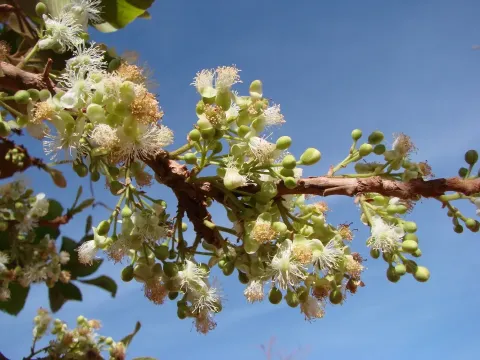
Curatella
Curatella
Curatella americana is a woody plant belonging to the Dilleniaceae family. Known often as the "sandpaper tree," it thrives in tropical environments and is a dominant species in South and Central American savannas.
What the section contains

Curatella
The plant is highly adapted to nutrient-poor, rocky, or acidic soils. Its root system is developed to penetrate hardened ground, making it resilient in harsh edaphic conditions where other crops would fail.
Sunlight is a critical requirement for Curatella. As a heliophilous species, it requires full sun exposure for both its vegetative growth and the development of its characteristic flowers.
Temperature regimes in its habitat remain consistently high, typical of tropical belts. The plant exhibits xerophytic adaptations, allowing it to survive extreme water deficit during prolonged dry seasons.
Management of this species in semi-natural settings requires preserving the natural fire-grazing cycle, as the plant is evolved to cope with periodic savanna disturbances.
The utility of Curatella is defined by non-timber forest product harvesting rather than conventional yield per hectare. It serves essential local needs in rural tropical communities.
The primary yield is the leaves, which possess a rough, abrasive surface due to silica deposits. They are traditionally collected for use as natural sandpaper to smooth wood surfaces.
Bark harvesting provides a significant source of tannins, which are used in local leather tanning processes, demonstrating the plant's economic importance.
The wood is harvested for construction and rural infrastructure due to its high density and resistance to decay, providing durable material for agricultural posts and tools.
Medicinal preparations derived from the plant's various parts constitute a secondary but valuable form of yield, often utilized in traditional ethnomedicine.
Curatella is remarkably hardy and resistant to most common fungal and bacterial diseases that affect tropical vegetation, largely due to its robust leaf structure.
Insect herbivory represents the most common biological threat, particularly to young seedlings, which can suffer from defoliation by various savanna-dwelling insects.
Physiological stress occurs when soil drainage is poor; waterlogged conditions can lead to root system decay, which is highly detrimental to this drought-adapted species.
High-frequency fire events can be a threat to the regenerative capacity of populations, as intense heat can damage the cambium layer of younger, smaller stems.
Land-use conversion for intensive agriculture and cattle ranching poses the greatest threat to its presence in wild landscapes, leading to habitat fragmentation.