
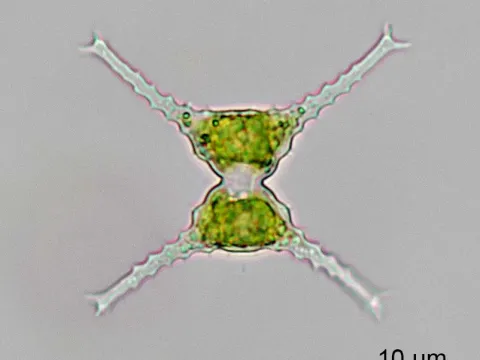
Staurastrum
Staurastrum
Staurastrum is a genus of unicellular green algae belonging to the family Desmidiaceae. While not a conventional agricultural crop, it represents a significant component of freshwater phytoplankton, contributing to the biodiversity and food webs of aquatic ecosystems.
What the section contains

Staurastrum
The genus has a global distribution, inhabiting a wide range of freshwater environments including lakes, ponds, and wetlands. These algae are known for their ability to thrive in diverse climatic zones, provided the water chemistry remains suitable for their development.
Botanically, Staurastrum cells are characterized by their unique, complex symmetry. Each cell typically consists of two semi-cells connected by a narrow isthmus, often featuring distinct radiating processes or spines, which give the organism its iconic star-like appearance under magnification.
Environmental requirements for Staurastrum include well-oxygenated water with sufficient light penetration for photosynthesis. They are generally sensitive to water quality and prefer environments that are not excessively eutrophic, maintaining a balance in mineral nutrient levels.
Agricultural techniques are not applied to this organism. Instead, its growth is regulated by the natural biogeochemical cycles of the water body. They perform essential metabolic processes through direct absorption of nutrients from the aqueous environment.
The primary threats to Staurastrum populations involve environmental degradation, specifically the runoff of chemical fertilizers and pesticides from surrounding farmland. Such pollutants can rapidly alter the delicate chemical balance required for their survival.
Eutrophication, driven by excessive nitrogen and phosphorus input, promotes the overgrowth of competing cyanobacteria. This shift in water quality frequently leads to the displacement and eventual local extinction of Staurastrum species due to shading and resource competition.