
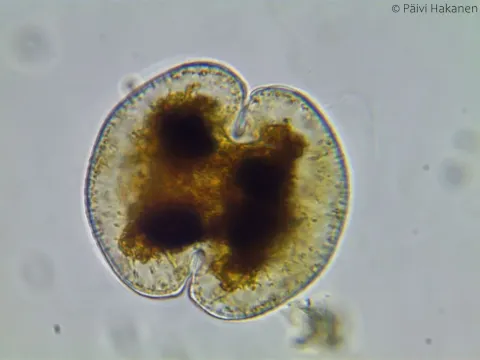
Cosmarium
Cosmarium
Cosmarium is a widespread genus of desmid green algae belonging to the Desmidiaceae family. These microscopic unicellular organisms are primarily found in freshwater habitats, ranging from ponds and lakes to damp soils.
What the section contains
Cosmarium
The morphology of Cosmarium is distinctive, consisting of two semi-cells connected by a narrow central isthmus containing the nucleus. The cell wall is often decorated with intricate patterns, such as pores, granules, or spines, which serve as taxonomic markers.
These algae thrive in oligotrophic or mesotrophic waters with neutral to slightly acidic pH levels. Adequate light penetration is a critical factor for their survival, as they rely heavily on photosynthesis for energy production.
In terms of ecological significance, Cosmarium species serve as vital bioindicators. Their presence is often used to assess the water quality and health of aquatic ecosystems, as they are highly sensitive to anthropogenic pollution.
For research and biotechnological applications, cultivation requires controlled environmental conditions. This includes specific nutrient-enriched media and regulated light cycles to support active cell division and biomass accumulation.
The primary threats to Cosmarium populations include water pollution and excessive nutrient enrichment, known as eutrophication. Such environmental degradation causes competing algae species to overtake the habitat.
Pathogenic infections by chytrid fungi significantly damage cell colonies. These fungi infiltrate the cell wall, absorbing nutrients and eventually killing the host organism, leading to population crashes.
Heavy metal toxicity and the presence of agrochemical residues can severely inhibit cellular growth. Exposure to these contaminants disrupts the photosynthetic machinery and causes irreparable damage to the cellular structure.
Predation by zooplankton, including rotifers and micro-crustaceans, acts as a natural pressure on population density. While part of the ecosystem, intense grazing pressure can limit the development of localized algal blooms.
Climate instability, particularly rapid changes in water temperature and alkalinity, hampers the development of Cosmarium. When environmental conditions become harsh, these algae may form resistant zygospores to survive until favorable conditions return.