
Micrasterias
Micrasterias
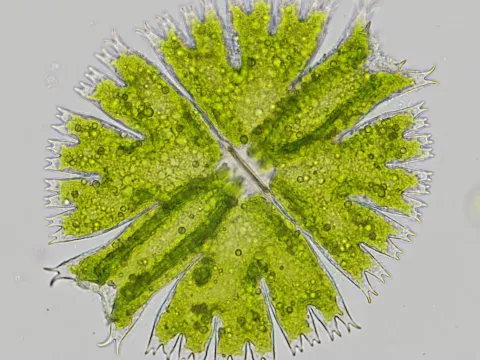
Micrasterias is a genus of charophyte green algae belonging to the Desmidiaceae family. It is not an agricultural crop but is a significant genus in phycology, widely studied for its complex, symmetrical, and flattened cell morphology.
What the section contains

Micrasterias
The habitat requirements for this organism center around oligotrophic freshwater environments. They are typically found in acidic waters, such as peat bogs, marshes, and pristine forest pools where nutrient levels, particularly nitrates and phosphates, remain very low.
Botanically, the cell is composed of two symmetrical semi-cells connected by a narrow isthmus. The intricate, lobed, and indented margins of the cells are species-specific and provide a high surface-to-volume ratio, which is beneficial for light harvesting.
Since this is not a commercial crop, there are no standard sowing or harvesting procedures. However, in laboratory settings, researchers use modified freshwater media to support their growth, ensuring controlled temperature and light cycles to mimic natural aquatic conditions.
Environmental health is vital for Micrasterias survival. Their presence is often used as a biological indicator of clean, unpolluted water. The species is highly sensitive to chemical runoff, which inhibits their growth and shifts the competitive balance in the water column.