
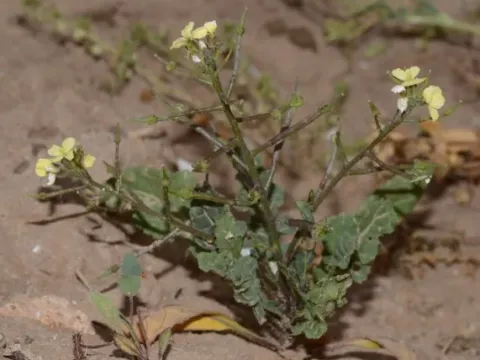
Cordylocarpus
Cordylocarpus
Cordylocarpus is a plant species belonging to the Brassicaceae family. It typically follows an annual life cycle, which dictates the timing and management of its sowing practices in an agricultural setting.
What the section contains

Cordylocarpus
The seeds require sufficiently warmed soil to germinate effectively, making mid-spring the ideal time for sowing, specifically after the threat of frost has completely passed.
Preparation of the field involves deep cultivation to ensure proper soil structure, which facilitates aeration and root penetration, essential for early plant development.
Standard row sowing is employed, with inter-row spacing maintained at approximately 45 cm to allow the plants enough room to develop robust vegetative rosettes.
Post-sowing irrigation is crucial to settle the seeds and ensure consistent soil moisture, which helps achieve uniform emergence across the entire field.
The crop thrives in temperate climates and requires consistent rainfall during the growing season, though it can tolerate short intervals of dry conditions once established.
Optimal growth is observed in well-drained sandy loam or light clay soils with a neutral to slightly alkaline pH, which prevents water stagnation and root diseases.
As a light-loving species, Cordylocarpus requires open, sunny locations. Shading from other crops or trees significantly limits biomass production and physiological development.
Integrated mineral fertilization, particularly during the early leaf formation phase, helps maximize the crop's yield potential and strengthens its resilience against stressors.
Proper drainage is essential; the crop is highly sensitive to waterlogged soils, which can lead to rapid root decay and loss of vigor throughout the planting area.
Yield efficiency in Cordylocarpus is closely tied to the quality of soil preparation and the precision of the weed control measures applied during the vegetative stage.
When managed under favorable conditions, the plant is capable of producing significant vegetative biomass, which holds potential for various agricultural applications.
Harvesting for biomass should occur at the onset of the flowering stage, a period when the plant tissues contain the highest concentration of desired chemical constituents.
For seed production, yield is calculated based on the total mass of healthy, well-filled pods, necessitating a harvest strategy that prevents shattering losses.
Regular maintenance of the field and consistent monitoring of plant health throughout the season are key factors in achieving stable and productive harvest outcomes.
Like many members of the Brassicaceae family, Cordylocarpus is susceptible to several common pests, including the flea beetle, which can devastate young seedlings.
Fungal diseases, such as downy mildew or Alternaria, can occur in environments with high relative humidity and poor air circulation, requiring careful field management.
Clubroot is a significant threat in acidic soils, making proper soil pH management and lime application essential preventative measures for sustainable production.
Integrated pest management, including crop rotation and the timely use of targeted fungicides or insecticides, is necessary to mitigate risks and maintain crop viability.
Early identification of pest or disease outbreaks is critical; swift intervention can often save the crop and prevent the spread of infections to neighboring fields.
The harvesting process for Cordylocarpus requires careful timing, as the pods tend to shatter and release seeds prematurely if left in the field for too long.
A two-stage harvesting method, involving cutting the plants into windrows to allow for uniform drying followed by threshing, is generally the most effective approach.
When harvesting for biomass, specialized machinery should be used to ensure an even cut, facilitating efficient handling and processing of the gathered material.
Ensuring that the harvested product reaches the correct moisture content is vital to preventing spoilage, mold development, and self-heating during storage.
Proper cleaning and grading of the harvest are the final steps, ensuring that the agricultural product meets quality standards and is ready for further usage.