
Cordylocarpus muricatus
Cordylocarpus muricatus
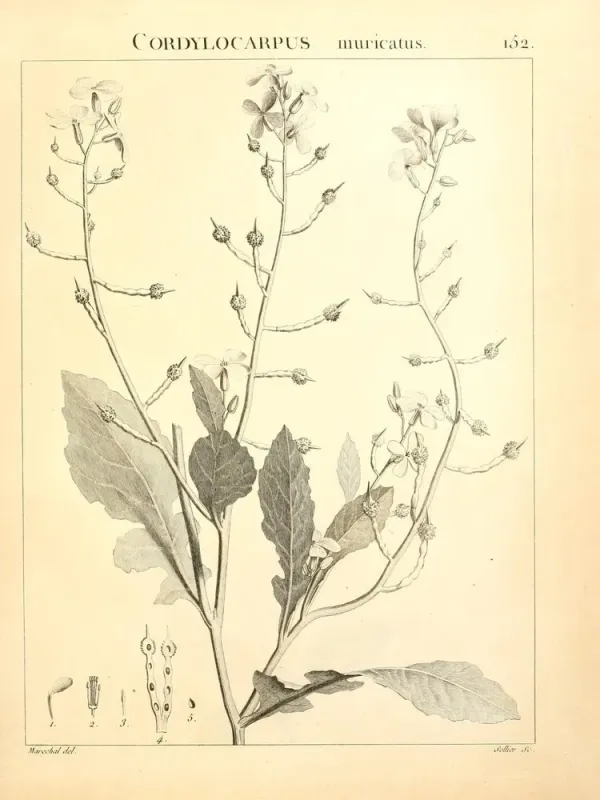
Description
Growing requirements
Cordylocarpus muricatus is a herbaceous plant species belonging to the Brassicaceae family. It is native to specific arid and semi-arid regions, primarily located in Southern Africa, where it has evolved unique survival mechanisms against water scarcity.
The botanical structure of the plant is characterized by a high degree of specialization for dry environments. Its morphology allows it to thrive in sandy and nutrient-poor soils where conventional crop plants would struggle to establish and maintain biological functions.
Agronomic requirements for this species include high solar radiation and low soil moisture levels. The plant is highly sensitive to waterlogging, as its root system is adapted to oxygen-rich, well-drained substrate conditions rather than stagnant or water-saturated environments.
Regarding climate, Cordylocarpus muricatus thrives in environments with high daytime temperatures and significant diurnal temperature variation. This thermal resilience is one of its most critical traits for survival in extreme climatic conditions.
In terms of agricultural utility, while not a mass-market crop, it is of significant interest for genetic research. Scientists study its genome to identify stress-tolerance markers that could eventually be transferred to more common Brassicaceae crops through modern breeding techniques.