
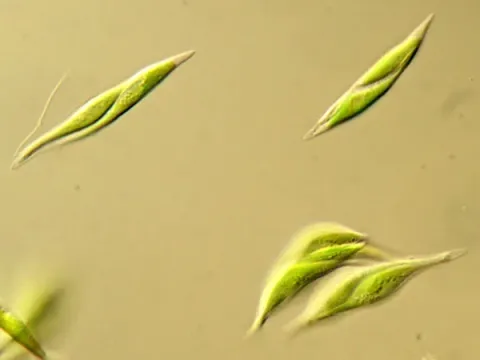
Ankistrodesmus
Ankistrodesmus
Ankistrodesmus is a genus of green microalgae belonging to the Selenastraceae family. It is not an agricultural crop in the traditional sense, as its cultivation relies on phycological methods and biotechnological processes within bioreactors or open pond systems.
What the section contains

Ankistrodesmus
The cultivation process begins by isolating a pure culture under laboratory conditions to select a high-performing strain. Scaling up follows a multi-stage approach, gradually increasing the culture volume to reach industrial productivity levels.
The life cycle of Ankistrodesmus is characterized by rapid cell division under optimal light and mineral nutrition conditions. The process requires constant monitoring of cell density to prevent growth inhibition caused by resource depletion or the accumulation of metabolic waste products.
Optimal timing for initiating production cycles depends on regional climatic conditions when using open pond systems. In closed systems, however, cultivation can occur year-round regardless of season, provided that a stable temperature regime is maintained.
Maintaining a healthy culture requires periodic inoculation and replenishment of the nutrient medium. This ensures that the population remains in the exponential growth phase, which is the most productive state for accumulating biomass.
Ankistrodesmus requires a precisely balanced nutrient medium, primarily consisting of nitrogen, phosphorus, potassium, and various micronutrients. The pH level is a critical parameter, usually maintained within a slightly alkaline range to ensure stable development.
High-quality illumination is essential for photosynthetic activity. In bioreactors, artificial lighting with a controlled spectrum is often used to maximize the synthesis of specific compounds, such as lipids or carbohydrates, within the algal cells.
Temperature is a key factor influencing survival. Most Ankistrodesmus species prefer moderately warm conditions, as significant temperature fluctuations can lead to cell division arrest or total population collapse.
Aeration with carbon dioxide (CO2) is mandatory to support photosynthesis and regulate pH levels. Dosage must be precisely calibrated to avoid excessive acidification of the medium, which could become detrimental to the culture.
In open systems, protection from overheating during peak summer hours is necessary. Circulation systems are used to continuously mix the algal mass, ensuring uniform light access for every cell and preventing the biomass from settling on the bottom.
The productivity of Ankistrodesmus is measured by the rate of biomass accumulation per unit volume over time. Under favorable conditions, this indicator is quite high, making the microalgae a promising candidate for various biotechnological applications.
The biomass of Ankistrodesmus is rich in proteins, lipids, and carbohydrates, making it a valuable resource for animal feed production and biofuel development. The final chemical profile depends on the chosen nutrition strategy and lighting conditions.
Harvesting efficiency depends directly on the chosen technology for separating biomass from the medium. Advanced methods such as centrifugation, flocculation, or filtration minimize losses and ensure the purity of the final product.
In industrial settings, biomass yield is primarily limited by the availability of light energy. Therefore, the architecture of the reactors and the seeding density play a decisive role. Optimizing these parameters significantly increases dry matter output per unit area.
Consistency in yield is ensured by regular monitoring of culture purity. The presence of contaminants or invasive species can drastically reduce productivity, making strict quality control an integral part of the production process.
The main threat to Ankistrodesmus cultures is contamination by other, more aggressive algae species or microorganisms, such as rotifers, that graze on the culture. This necessitates strict adherence to sterile protocols during the initial growth stages.
Viral infections and pathogenic bacteria can devastate a population if sanitary standards are compromised. Prevention includes regular sterilization of feed lines and strict control over the quality of the initial inoculum.
Chemical imbalances in the medium often lead to chlorosis and metabolic slowdown. Failing to correct nutrient deficiencies promptly can result in the rapid degradation of the entire population and subsequent crop loss.
The accumulation of metabolites in aging cultures can cause self-inhibition of growth. Effective production requires regular refreshing of the medium to maintain a healthy physiological state of the microorganisms.
Using closed bioreactors helps minimize the influence of external factors, such as invasive species or weather events, rendering the production process more predictable and manageable.
Harvesting Ankistrodesmus involves extracting cells from the culture medium. Various dewatering methods are chosen based on the intended use of the product, which ultimately affects the quality and storage stability of the biomass.
Centrifugation is a fast and efficient method for concentrating biomass but involves high energy consumption. It is typically preferred when high-purity raw material is required for sensitive applications.
Flocculation using specialized, safe reagents significantly reduces costs for large-scale production. This approach is the most economically viable method for handling high volumes of culture medium.
Once separated, the biomass undergoes thermal drying or preservation. Maintaining gentle temperature regimes is crucial to prevent the degradation of biologically active compounds present in the algal cells.
The final product is utilized as a protein-rich feed additive or as feedstock for biotechnological processes. The water cleared of biomass can often be treated and recycled back into the production cycle, promoting sustainability.