
Bassia muricata
Bassia muricata
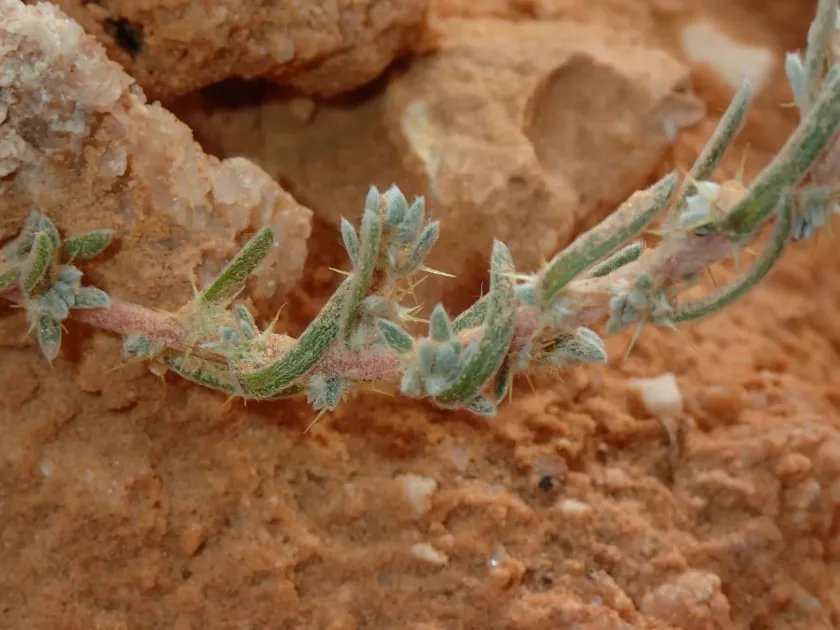
Description
Growing requirements
Bassia muricata is a specialized plant species belonging to the Amaranthaceae family. It is an annual herbaceous plant specifically adapted to thrive in harsh, desert-like environments where survival is challenging for most vegetation.
The native range of this plant extends across arid and semi-arid regions of North Africa, the Middle East, and parts of Central Asia. It is frequently found in environments characterized by high salinity levels and low annual rainfall.
As a halophytic plant, it demonstrates a unique physiological capacity to withstand high salt concentrations in the soil. It requires full sun exposure and warm temperatures to complete its life cycle effectively within its native ecosystem.
The botanical structure of the plant features small, alternate leaves and distinctive, spiny fruits. These spines are an evolutionary adaptation that facilitates seed dispersal by attaching to the fur of passing animals or by rolling across the desert floor.
In terms of land use, Bassia muricata primarily serves as a component of desert rangelands. It contributes to soil stabilization in fragile arid ecosystems, helping to mitigate desertification processes in its natural habitat.