
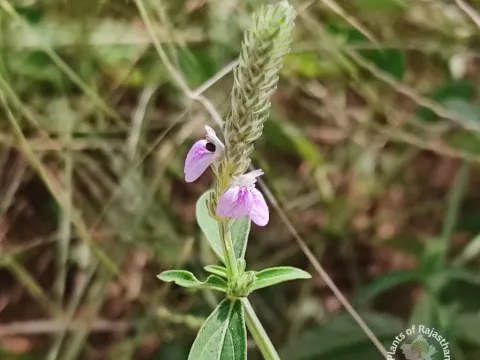
Justicia quinqeangularis
Justicia quinqeangularis
Justicia quinqeangularis, a member of the Acanthaceae family, is a herbaceous plant native to tropical environments. Agricultural cultivation primarily involves seed propagation in controlled greenhouse conditions to ensure maximum germination rates.
What the section contains
Justicia quinqeangularis
Sowing should take place in late winter or early spring using a sterile, well-draining potting medium. Seeds should be sown at a depth of 0.5 cm, as they require consistent moisture and moderate ambient temperatures to initiate the sprouting process.
Propagation through cuttings is also a viable agricultural practice. Softwood cuttings taken from healthy, vigorously growing mother plants establish well in high-humidity environments, usually within a three-week period.
Transplanting seedlings to the final production beds or larger containers is recommended once the plants develop several sets of true leaves. Careful handling of the root ball is essential to prevent transplant shock and maintain steady vegetative growth.
For commercial cultivation, spacing is maintained at approximately 30–40 cm between plants to ensure adequate airflow and prevent the development of localized humidity pockets that could harbor pests or pathogens.
The plant thrives in nutrient-rich, loamy soils with high organic matter content. A soil pH range of 6.0 to 7.0 is ideal for maximizing nutrient uptake and ensuring optimal growth of the plant's unique pentagonal-structured stems.
Consistent irrigation is vital for Justicia quinqeangularis. While the soil should be kept uniformly moist, excessive saturation must be avoided to prevent root rot, particularly in heavier soil types.
Bright, indirect light is necessary for healthy development. In intense tropical sun, partial shade is beneficial to prevent foliage scorch, ensuring that the plant maintains its structural integrity and leaf color intensity.
Temperature management is crucial, with the plant performing best between 22 and 28 degrees Celsius. Protection from frost and extreme cold is mandatory, as Justicia quinqeangularis is highly susceptible to chilling injury.
Regular fertilization with a balanced, water-soluble fertilizer during the peak growth season supports the development of lush foliage. Micronutrient supplementation may be required if soil analysis indicates deficiencies.
Pest management focuses primarily on controlling spider mites, which thrive in environments where air circulation is poor and humidity levels are low. Periodic misting and the use of appropriate miticides help mitigate infestations.
Fungal diseases, specifically those affecting the roots, are a significant threat. Over-irrigation and poor drainage contribute to the proliferation of Phytophthora and Pythium species, which can cause rapid plant decline.
Leaf spot diseases, caused by various bacterial and fungal pathogens, may occur during seasons with prolonged rain or high humidity. Maintaining leaf dryness and improving garden hygiene significantly reduces the incidence of these infections.
Aphids and whiteflies can occasionally cause stress to the plant by feeding on sap and excreting honeydew, which leads to sooty mold growth. Early identification and manual removal or insecticidal soap applications are effective controls.
Integrated Pest Management (IPM) practices, including the use of biological control agents and resistant cultivars, are recommended for maintaining long-term health and productivity in larger agricultural plots.