
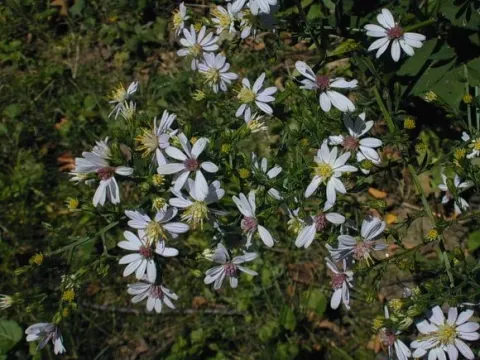
Arrow-leaved aster
Aster sagittifolius
Sowing seeds of the arrow-leaved aster in open ground is mainly carried out in spring, once the soil has warmed up sufficiently, or before winter in late October. For early blooming, a seedling method is practiced, involving sowing seeds in trays during March.
What the section contains
Arrow-leaved aster
When using the seedling method, seeds are sown in a nutrient-rich substrate at a depth of no more than 0.5 cm. It is crucial to maintain a stable temperature of about 18-20 degrees Celsius until germination occurs, after which the seedlings should be moved to a cooler location.
Pricking out (transplanting) of the seedlings is performed once the stage of two true leaves is reached. The plants tolerate transplantation well if the root ball remains intact, which is critical for their survival and establishment in their permanent location.
Seedlings are planted into the ground in May, after the risk of late spring frosts has passed. The planting scheme should account for the future habit of the bush: an optimal distance of 40-50 centimeters between individual plants is recommended to ensure good air circulation.
Propagation is also possible vegetatively by dividing the rootstock. This procedure is best performed in spring or late summer when the plant is in a phase of relative dormancy following the end of its active growth cycle.
The arrow-leaved aster (Aster sagittifolius) belongs to the Asteraceae family and is a perennial herbaceous plant native to North America. In the wild, it is most commonly found in open woodlands and meadow areas.
The crop has moderate soil fertility requirements but thrives best in well-drained, loamy soils with a neutral or slightly acidic pH level.
This plant is quite winter-hardy, allowing it to be cultivated across various climatic zones. It prefers open, sunny locations or sites with light partial shade where a sufficient level of air humidity is maintained.
Botanically, the species is characterized by sagittate (arrow-shaped) basal leaves, which gives it its common and specific name. The stems reach heights of 60 to 120 cm, terminating in paniculate inflorescences composed of numerous small flower heads.
In cultivation, it is important to provide moderate watering while avoiding moisture stagnation in the root zone. Mulching the soil around the bushes helps maintain an optimal temperature regime and preserves the structure of the topsoil layer.
The primary disease affecting this species is powdery mildew, which frequently attacks the foliage during periods of high humidity and poor air circulation.
To prevent the development of fungal infections, it is recommended to carry out preventive fungicide treatments and remove infected plant debris from the site in a timely manner.
Among pests, aphids and spider mites pose the greatest threat, as they suck sap from young shoots and flower buds, significantly reducing the ornamental quality of the crop.
Slugs and snails can damage young leaves in spring; therefore, if necessary, barrier methods of protection or specific molluscicides should be applied in the root zone.
- Strict adherence to crop rotation and spacing during planting.
- Regular inspection of plants for the presence of pest colonies.
- Timely weeding to eliminate plants that act as disease reservoirs.
The economic use of the arrow-leaved aster is predominantly decorative. Harvesting of flower heads for bouquets is recommended when most of the individual flowers in the inflorescence are fully opened.
Cut stems retain freshness in a vase for 7-10 days, provided the water is changed daily and the stems are trimmed at an angle to facilitate better moisture uptake.
To collect your own seed material, wait until the achenes are fully ripe and begin to separate easily from the seed head. Harvesting should take place in dry weather, followed by drying the seeds in a well-ventilated room.
After the flowering period ends, it is recommended to cut the stems down to the ground level, which stimulates the plant to develop a more robust root system and form buds for the following season.
The plant is excellent for creating naturalistic landscapes, wild gardens, and serves as an effective cut flower, maintaining high ornamental value until late autumn.