
Hinds walnut
Juglans hindsii (Jeps.) R. E. Sm.
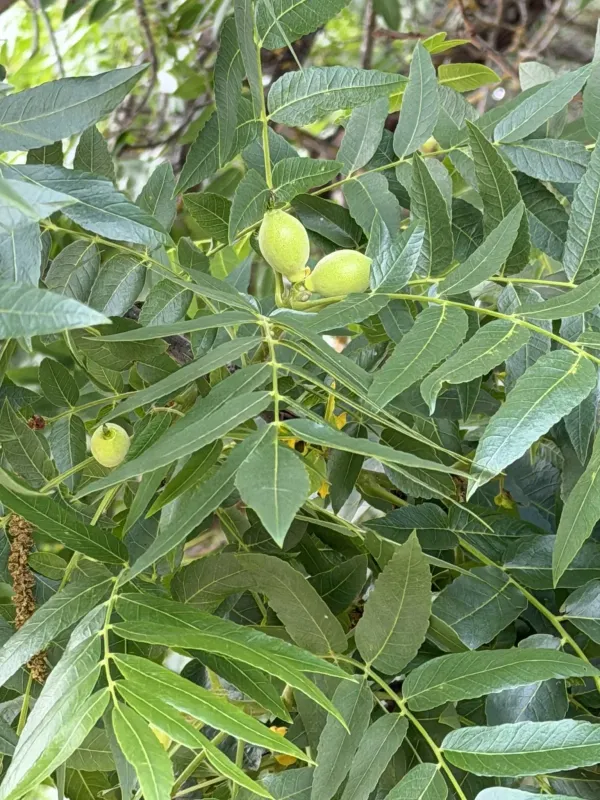
Description
Growing requirements
Hinds walnut (Juglans hindsii) is a deciduous tree species within the Juglandaceae family, native to Northern California. In its natural habitat, it develops into a large, sturdy tree with an expansive crown, frequently used for its unique physiological traits.
This species thrives in deep, fertile, and well-draining alluvial soils. It is notably resilient compared to other walnut species, showing a remarkable ability to tolerate saline conditions and temporary waterlogging, which makes it an essential plant for breeding purposes.
Climate requirements for the Hinds walnut involve a Mediterranean-type environment with long, warm summers and mild winters. While established trees exhibit some tolerance to cold, the species is generally adapted to areas where extreme freezing temperatures are infrequent.
The primary economic use of Juglans hindsii is as a rootstock. Due to its vigorous growth habit and resistance to certain soil-borne pathogens, it is extensively used in grafting projects to produce hybrid rootstocks, such as the widely known 'Paradox' walnut.
Botanically, the tree features dark, deeply furrowed bark and compound, pinnate leaves. The nuts produced by this tree are characterized by a thick, smooth shell with a relatively low kernel percentage, which limits its value for direct commercial food production compared to the common walnut.
Main diseases and pests
The most significant threat to Hinds walnut populations is crown and root rot caused by Phytophthora species, especially when trees are planted in poorly drained or heavy-textured soils.
The walnut husk fly is a common pest that impacts the quality of the harvest. By laying eggs in the husks, the larvae cause significant damage that can result in stained and ruined nut kernels.
Bacterial blight (Xanthomonas arboricola) represents a major risk, particularly in cool and humid spring weather, leading to necrosis on leaves, catkins, and new branch growth.
Armillaria root rot is another persistent issue, often occurring in orchards planted on newly cleared lands where old tree stumps or roots remain in the soil.
Effective management includes maintaining optimal irrigation levels, implementing integrated pest management (IPM) practices, and ensuring proper air circulation within the orchard to minimize humidity-related diseases.