
Columnea
Columnea hybrids
Description
Growing requirements
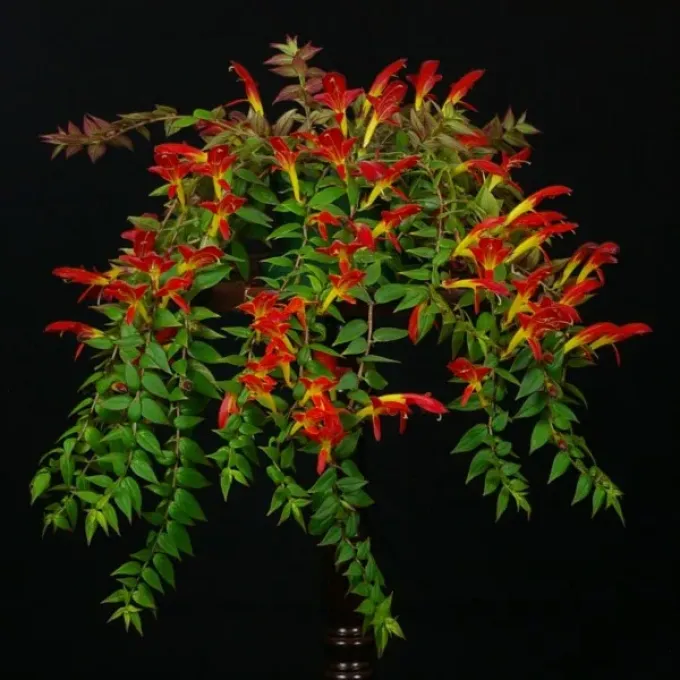
Columnea (Columnea hybrids) is a prominent member of the Gesneriaceae family. Known for its trailing habit and vibrant tubular flowers, this plant functions as an epiphyte in its natural habitat, native to the tropical regions of Central and South America.
For optimal growth, Columnea requires bright, filtered light. While it thrives in indoor settings, protection from direct midday sun is necessary to prevent leaf scorch, which can significantly damage the succulent-like foliage.
The cultural requirements demand high ambient humidity, ideally above 60%. As epiphytes, they prefer a well-aerated growing medium. A mixture of peat moss, perlite, and orchid bark is recommended to provide adequate drainage and air circulation to the root system.
Temperature management is crucial; the plant performs best in a range of 20°C to 25°C. It is sensitive to sudden cold drafts and temperature fluctuations, which can trigger leaf drop and inhibit the development of flower buds during the growing season.
Routine maintenance includes systematic pruning to maintain the plant's shape and encourage denser growth. As an ampelous crop, pruning ensures that the stems do not become excessively woody and maintains the aesthetic value of the cascading branches.
Main diseases and pests
Common pests affecting Columnea hybrids include spider mites, which thrive in dry indoor environments, as well as mealybugs. Integrated pest management, including regular washing of leaves and use of appropriate miticides, is essential for control.
Root rot, caused by waterlogged soil and poor drainage, represents the most significant pathological threat to the crop. Utilizing a porous substrate and ensuring that the pot does not sit in standing water are the primary preventative measures.