
Blue prickly pear
Opuntia azurea
Description
Growing requirements
Opuntia azurea, commonly known as the blue prickly pear, is a perennial succulent shrub belonging to the Cactaceae family. This species is native to the arid landscapes of northern and central Mexico, where it has adapted to high heat and scarce water supplies.
For successful cultivation, the plant requires well-draining, sandy, or rocky soil with a slightly alkaline or neutral pH. Good soil aeration is essential, as the plant is highly susceptible to root decay if water remains stagnant in the root zone.
The climate requirements emphasize full sun exposure for the majority of the day. This intensity is necessary to maintain the plant's signature azure-gray coloration of the pads, which serves as a natural sun-shielding mechanism.
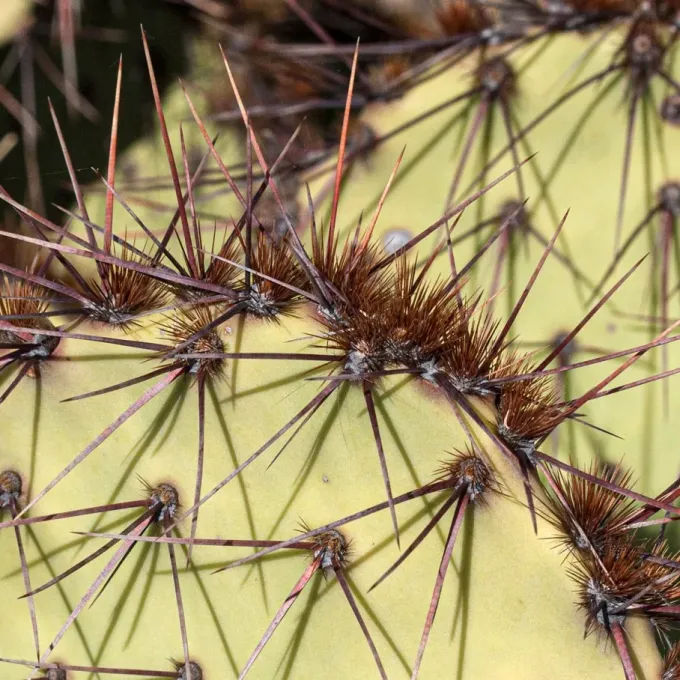
Botanically, the plant consists of flattened, circular, or obovate pads covered in sharp spines. These spines protect the water-rich internal tissues from herbivores, a crucial survival trait in its native desert habitat.
Temperature management should mirror desert conditions: warm days and cooler nights. While the species can tolerate light frosts, prolonged freezing temperatures require protective measures to prevent tissue damage.
Yield
The economic value of Opuntia azurea is diverse, spanning from specialized food production to ornamental landscaping. In its native range, young pads are harvested as 'nopales,' providing a vegetable source rich in minerals and fiber.
The fruits are highly valued for their nutritional profile, containing antioxidants and Vitamin C. They are processed into juices, jellies, and natural food colorants, which are increasingly sought after in the functional food market.
In rural agriculture, this cactus serves as an emergency fodder crop for livestock. During severe droughts, the succulent pads provide necessary moisture and nutrients when traditional grass crops fail, ensuring herd survival.
Ornamental use is another significant sector, as the unique blue-gray hue of Opuntia azurea makes it a premium choice for drought-tolerant xeriscaping. It is often featured in botanical gardens and private dry-climate landscapes.
Efficient management involves selective harvesting of pads and fruits. Sustainability is key, as the slow growth rate of the plant requires a long-term strategy for crop rotation and field regeneration.
Main diseases and pests
Fungal diseases, particularly root and stem rots, represent the most significant threat to Opuntia azurea. These issues are almost exclusively caused by overwatering or poor drainage systems in the plantation.
Pests such as mealybugs and spider mites are frequent invaders. They feed on the succulent tissues of the pads, weakening the plant's structural integrity and making it vulnerable to secondary infections.
Pest management relies on cultural controls such as spacing plants to ensure maximum airflow and manually removing infested areas. Chemical treatments must be selected carefully to avoid harming the delicate skin of the succulent.
Nematode infestations can also occur in soil that has not been properly treated. Maintaining a clean cultivation environment is essential to prevent these soil-borne pathogens from disrupting the plant's growth cycle.
In greenhouse settings, high humidity is the enemy. Regular ventilation and climate control are non-negotiable to prevent the buildup of damp air, which triggers mold growth on the cactus pads.