
Wissadula rostrata
Wissadula rostrata
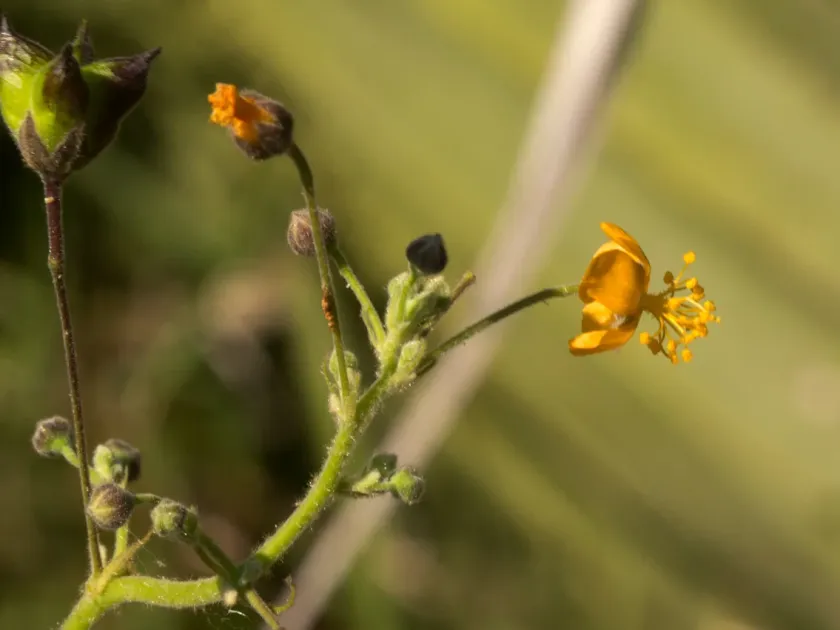
Description
Sowing dates
Wissadula rostrata is a tropical plant, so its sowing timing is directly dependent on the onset of the rainy season in specific growing regions. In equatorial and subequatorial climates, planting is performed immediately after stable precipitation begins to ensure seeds have the necessary moisture for germination.
The optimal soil temperature for the beginning of vegetation should be at least 20–25 degrees Celsius. It is crucial to avoid sowing in waterlogged or cold soil, as this triggers seed rot and slows down root system development during the early stages.
Plant density in industrial cultivation is selected to ensure maximum yield of stems suitable for fiber extraction. Typically, row planting is used with spacing that allows for mechanical field maintenance and inter-row cultivation.
Since the crop is sensitive to day length, the choice of sowing time can affect the transition to the flowering phase. Agronomists recommend consulting regional phenological observation maps to optimize the field work schedule.
For a successful start, the application of base fertilizers is necessary, providing a sufficient nitrogen level for the active growth of vegetative mass, which constitutes the core economic value of this species.
Growing requirements
Wissadula rostrata belongs to the Malvaceae family and is an herbaceous or semi-shrubby perennial, exhibiting annual crop properties in temperate climate zones. Its natural range covers tropical regions of the Americas, where it grows in open areas.
The crop has high requirements for temperature regimes: stable high temperatures without sharp fluctuations are necessary for full development. The plant poorly tolerates frosts, which are detrimental to the condition of the stem tissues.
Soils for Wissadula cultivation must have good aeration and drainage. Best results are achieved on loose loams and alluvial soils rich in organic matter, which retain moisture without allowing it to stagnate.
The plant has moderate drought resistance, but stable moisture is required during the active growth period to produce high-quality fiber. Water deficiency leads to stem lignification and degradation of its physical and mechanical properties.
In its natural environment, the species is found in sunny forest edges and fields, indicating a high demand for intense solar illumination. Shading leads to stem elongation and a decrease in the plant's overall biomass.
Yield
The main indicator of Wissadula rostrata yield is the mass of dry stems suitable for obtaining bast fiber. Yield varies significantly depending on the quality of agronomy and the genetic potential of the selected plant ecotype.
Under intensive cultivation with mineral fertilizers and irrigation systems, stem mass yield can reach significant figures comparable to other Malvaceae members used in the textile industry.
Fiber quality depends directly on the time of harvest: if the plants are over-mature, the fiber becomes coarser and more brittle. Harvesting is scheduled at the onset of flowering, when the accumulation of bast fibers peaks before lignin overloads the stem structure.
In the stem processing stage, fiber yield depends on cleaning and primary processing methods, such as retting or mechanical decortication. The use of modern technologies allows for an increased percentage of high-quality raw material output.
Seed productivity is also an important parameter for selection. Well-developed specimens can produce a large quantity of seeds, allowing for the rapid propagation of the most valuable clones with stable economic traits.
Main diseases and pests
Like many other members of the Malvaceae family, Wissadula rostrata can be affected by a complex of specific pests. The most dangerous are insects that damage vegetative mass and seed pods during their maturation period.
Typical pests include the cotton bollworm and other Lepidoptera species, whose larvae can destroy a significant portion of green mass. Regular field monitoring is necessary for the timely application of biological agents or insecticides.
Among fungal diseases, the greatest threats are leaf spots and root rots, occurring when the soil hydrological regime is disturbed. Excessive humidity creates an ideal environment for the development of pathogens.
Disease prevention includes following crop rotation rules, where Wissadula is not planted in fields that previously hosted related Malvaceae crops (cotton, kenaf). This reduces the risk of specific pathogen accumulation in the soil.
Weed vegetation in the initial stages of crop growth can seriously suppress seedlings. Mechanical weeding in the first 4–6 weeks after sowing is a critical measure to ensure the normal development of the plantation.
Harvesting
Harvesting Wissadula rostrata requires specialized machinery to cut the stems at the necessary height. The process must be synchronized with the schedule of subsequent primary fiber processing to prevent drying or premature rotting.
After mowing, the stems usually undergo a preliminary drying stage in the field, which facilitates the subsequent separation of fiber from the woody stem core (shives). In industrial settings, high-performance harvesters are used to perform cutting and primary sorting.
Transportation of the collected raw material must be carried out under conditions that exclude wetting, as damp fiber quickly loses strength and changes color, which is critical for its market quality in the textile industry.
To preserve fiber integrity, it is important to avoid mechanical damage to the stems during harvest. Careful handling contributes to obtaining a longer and higher-quality fiber output, which directly determines the market value of the final product.
Plant residues after fiber extraction can be used as organic fertilizer, returning a significant amount of nutrients to the soil and improving its structure for subsequent agricultural cultivation cycles.