
Vigna caracalla
Vigna caracalla
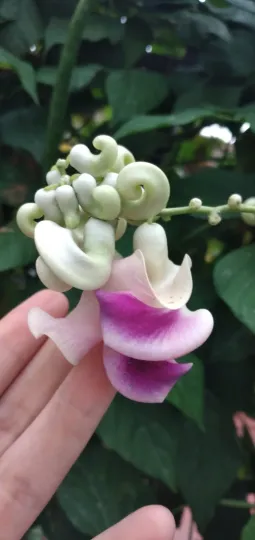
Description
Sowing dates
Vigna caracalla, commonly referred to as the snail vine or corkscrew vine, is a perennial flowering plant in the Fabaceae family. It is prized for its uniquely coiled, fragrant flowers that resemble snail shells.
Propagation is primarily done via seeds, which should be scarified and soaked in warm water for 24 hours prior to planting to enhance germination rates. Sowing in pots is recommended in late winter.
The seeds should be planted in a light, well-draining potting mix at a depth of about 2 centimeters. Maintaining a warm environment, ideally between 22 and 25 degrees Celsius, is essential for successful sprouting.
Transplanting into the garden or final containers must occur only when all risks of frost have passed. As a tropical species, the snail vine thrives when night temperatures remain reliably above 15 degrees Celsius.
Provide a sturdy trellis or support structure immediately upon transplanting. The plant is a vigorous grower, capable of scaling walls and fences, so the support system must accommodate significant weight.
Growing requirements
The snail vine requires a sunny position to produce its spectacular blooms. While it can tolerate partial shade, maximum sunlight exposure is crucial for the intensity of the flowers' color and fragrance.
Soil quality must be fertile and moisture-retentive, yet possess excellent drainage properties. Avoid heavy clay soils that compact easily, as they restrict root development and lead to suffocation of the plant.
Watering should be consistent; keep the soil evenly moist throughout the peak growing season. However, allow the surface layer to dry slightly between waterings to prevent the development of root-borne pathogens.
Apply a balanced liquid fertilizer every two weeks during the active growth stage. Focus on formulas higher in potassium and phosphorus to promote flowering, as excessive nitrogen results in lush foliage but fewer blooms.
Regular maintenance includes pruning away dead foliage and pinching back long, spindly shoots. This practice encourages branching and a more compact, aesthetically pleasing plant structure.
Main diseases and pests
Aphids are a common concern, particularly on the tender new growth and developing flower buds. These pests can be managed with insecticidal soaps or manual removal if the infestation is detected early.
Spider mites frequently attack the leaves during hot, dry spells. Maintaining high humidity around the foliage through misting or adequate spacing can significantly reduce the risk of spider mite outbreaks.
Root rot is the most common physiological issue, resulting from poor drainage or overwatering. Ensure that containers have sufficient drainage holes and that garden beds are not located in low-lying, damp areas.
Powdery mildew may manifest as a white, dusty layer on leaves when air circulation is poor. Improving ventilation and reducing overhead watering can help mitigate the conditions favorable to fungal growth.
Consistent monitoring and good garden hygiene are the best strategies for pest management. Removing infested plant parts immediately prevents the spread of insects and pathogens to the rest of the vine.