
Marble houseleek
Sempervivum marmoreum Griseb.
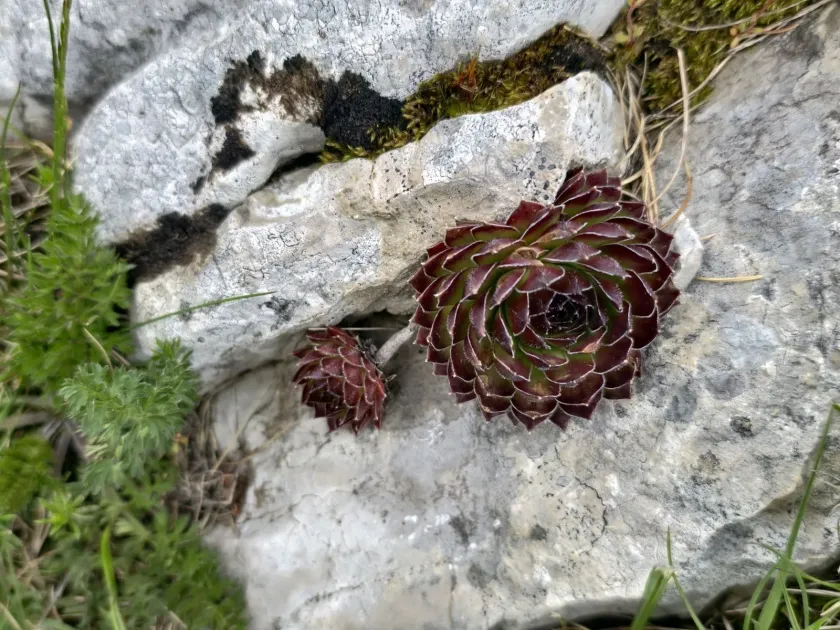
Description
Growing requirements
Marble houseleek (Sempervivum marmoreum) is a perennial succulent belonging to the Crassulaceae family. Native to the mountainous regions of Central and Southern Europe, it is well-adapted to rocky crevices and sparse environments.
The plant is characterized by its rosette form, consisting of fleshy leaves that are capable of storing water for long periods. This adaptation allows the marble houseleek to thrive in arid conditions where other crops would fail.
In terms of soil, it requires excellent drainage. It performs best in sandy or gravelly substrates that prevent water stagnation, which is the primary cause of root-related issues in this species.
Sunlight is critical for maintaining the marble houseleek's structural integrity and vibrant leaf coloration. It should be grown in full sun exposure; otherwise, the rosette will lose its compactness and become etiolated.
This crop is widely utilized in landscape architecture, particularly for rock gardens, green roof systems, and container gardening. Its ability to tolerate temperature extremes makes it an ideal choice for outdoor planting.
Main diseases and pests
The most significant threat to the marble houseleek is excess moisture leading to root rot. If the soil remains saturated for extended periods, the plant’s health will rapidly deteriorate, often causing death.
Root aphids pose a serious challenge, as they inhabit the root zone and are difficult to detect until the plant starts showing signs of wilting. They sap the vitality of the plant and often cause stunted growth.
Mealybugs are another common pest that targets the succulent foliage. They leave a white, cottony residue on the leaves and can spread rapidly between neighboring rosettes if not treated promptly.
Fungal leaf spots can occur when air circulation is poor or humidity levels are consistently high. Removing the affected leaves and improving the environment for the plant is the most effective way to manage these outbreaks.
Maintenance and pest control depend heavily on providing adequate spacing and ensuring the soil composition allows for rapid drying. Regular monitoring of the rosette centers helps catch potential infestations at an early stage.