
Dwarf umbrella tree
Schefflera arboricola (Hayata) Hayata ex Merr.
Description
Growing requirements
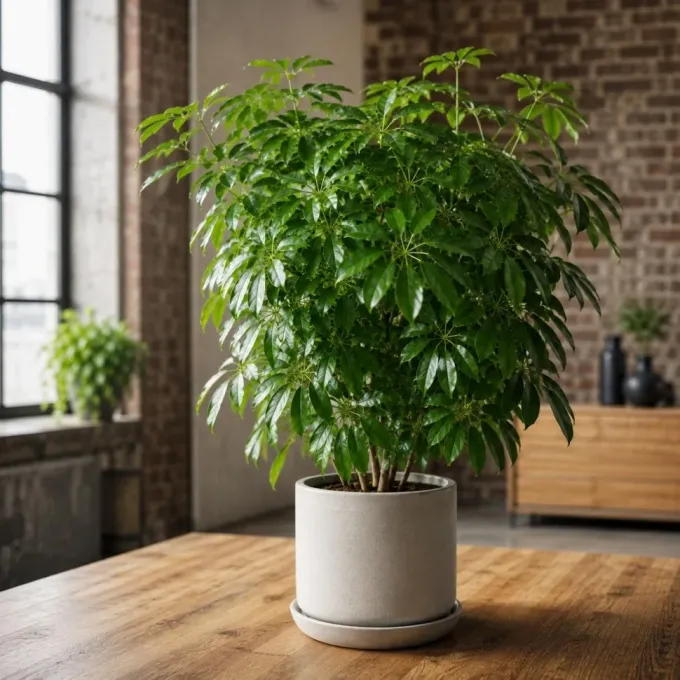
The dwarf umbrella tree (Schefflera arboricola) belongs to the Araliaceae family. Native to Taiwan and Hainan, this species has become a popular ornamental plant globally due to its lush, palm-like foliage and adaptability to indoor environments.
Cultivation requires bright, indirect light to maintain the variegation and density of the leaves. While the plant can tolerate lower light levels, it grows significantly faster and remains more compact under optimal luminosity conditions.
The soil requirements focus on well-draining, nutrient-rich potting mixes. A substrate consisting of peat, pine bark, and perlite provides the necessary aeration and moisture retention needed to prevent root rot in a container environment.
Agrotechnical practices involve maintaining a consistent moisture level during the growing season. It is essential to allow the top inch of the soil to dry out before watering again, ensuring the pot has adequate drainage holes.
Commercially, Schefflera arboricola is highly valued for indoor landscaping and air purification purposes. It is widely used in residential and commercial spaces to enhance aesthetics and improve indoor environmental quality through phytoremediation.
Main diseases and pests
Common pests affecting the dwarf umbrella tree include spider mites, mealybugs, and scale insects. These organisms thrive in environments with low humidity and poor air circulation around the canopy.
Fungal diseases, including leaf spot and root rot, are the most frequent health issues encountered. These are typically prevented by avoiding overhead watering and ensuring that the growing medium does not become waterlogged.